|
The technologies discussed in this subchapter essentially cover physical
processes for layer deposition as opposed to the more chemical methods introduced
in the preceding subchapters. In other words, we deal with some more techniques for the material
module in the process cycle for ICs. |
|
 |
While still intimately tied to the electronic materials to be processed, these
technologies are a bit more of a side issue in the context of electronic materials, and will therefore be covered in far less detail then the preceding, more material oriented deposition techniques. |
|
|
On occasion, however, a particular tough problem in IC processing is elucidated in
the context of the particular deposition method associated with it. So don't skip these modules
completely! |
|
Essentially, what you should know are the basic technologies employed for layer
deposition, and some of the major problems, advantages and disadvantages encountered with these techniques in the context
of chip manufacture. |
| |
It should be clear by now that the deposition of thin
layers is the key to all microelectronic structures (not to mention the emerging micro electronic and mechanical
systems (MEMS), or nano
technology). |
|
|
Chemical vapor deposition, while very prominent
and useful, has severe limitations and the more alternative methods exist, the
better. |
|
|
Physical methods for controlled deposition of thin layers
do exist too; and in the remainder of his subchapter we will discuss the major ones. |
|
What are physical methods as opposed to chemical methods? While there is no ironclad distinction, we may simply use the following rules |
|
|
If the material of the layer is produced by a chemical reaction
between some primary substances in-situ, we have a chemical deposition process. This does not just include the CVD
processes covered before, but also e.g. galvanic layer deposition. |
|
|
If the material forming the layer is sort of transferred from some substrate or source to
the material to be coated, we have a physical process. The most important physical processes
for layer deposition which shall be treated here are |
| | |
|
Basic Sputter Process |
| |
|
| |
"Sputtering" or "sputter deposition" is a conceptually simple technique: |
|
|
A "target" made of the material to be deposited is bombarded
by energetic ions which will dislodge atomes of the target, i.e., "sputter them off". |
|
|
The dislodged atoms will have substantial kinetic energies, and some will fly to the substrate
to be coated and stick there. |
|
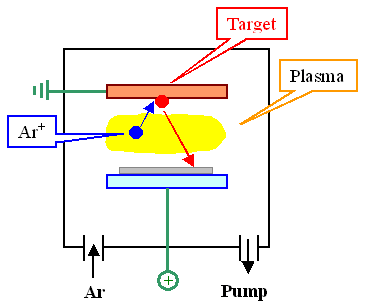
In practice, this is a lot easier than it appears. The basic
set-up is shown below: |
|
|
|
|
The ions necessary for the bombardment of the target are simply extracted from
an Ar plasma burning between the target and the substrate. |
|
|
Both target and substrate are planar plates arranged as shown above. They also serve as the
cathode and anode for the gas discharge that produces an Ar plasma, i.e. ionized Ar and free electrons, quite
similar to what is going on in a fluorescent light tube. |
|
|
Since the target electrode is always the cathode, i.e. negatively charged, it will attract
the Ar+ ions and thus is bombarded by a (hopefully) constant flux of relatively energetic Ar ions. |
|
|
This ion bombardment will liberate atoms from the target which issue forth from it in all
directions. |
|
Reality is much more complex, of course. There are many ways of generating the
plasma and tricks to increase the deposition rate. Time is money, after all, in semiconductor processing.
Some target
atoms will make it to the substrate to be coated, others will miss it, and some will become ionized and return to the target.
The important points for the atoms that make it to the substrate (if everything is working right) are: |
|
|
1. The target atoms hit the substrate with an energy large enough so they "get stuck", but not so large as to liberate substrate atoms. Sputtered layers therefore
usually stick well to the substrate (in contrast to other techniques, most notably evaporation). |
|
|
2.
All atoms of the target will become deposited, in pretty much the same composition as
in the target. It is thus possible, e.g., to deposit a silicide slightly off the stoichiometric composition (advantageous
for all kinds of reason). In other words, if you need to deposit e.g. TaSi2 - x with x »
0.01 - 0.1, sputtering is the way to do it because it is comparatively easy to change the target composition. |
|
|
3. The target atoms hit the substrate coming from all directions.
In a good approximation, the flux of atoms leaving the target at an angle F relative to
the normal on the target is proportional to cos F. This has profound implications for
the coverage of topographic structures. |
|
|
4. Homogeneous coverage of the substrate is relatively easy to achieve- just make the
substrate holder and the target big enough. The process is also relatively easily scaled to larger size substrates - simply
make everything bigger. |
|
Of course, there are problems, too. |
|
|
Sputtered layers usually have a very bad crystallinity - very small grains full of defects
or even amorphous layers result. Usually some kind of annealing of the layers is necessary to restore acceptable crystal
quality. |
|
|
Sputtering works well for metals or other somewhat conducting materials. It is not easy or
simply impossible for insulators. Sputtering SiO2 layers, e.g., has been tried often, but never made it
to production. |
|
|
While the cos F relation for the directions of the sputtered
atoms is great for over-all homogeneity of the layers, it will prevent the filling of holes with large aspect
ratios (aspect ratio = depth/width of a hole). Since contact holes and vias in modern ICs always have
large aspect ratios, a serious problem with sputtering Al(Si Cu) for contacts came up in the nineties of the last
century. This is elaborated in more detail below. |
|
More or less by default, sputtering is the layer deposition process of choice
for Al, the prime material for metallization. |
|
|
How else would you do it? Think about it. We already ruled
out CVD methods. What is left? |
|
|
The deposition of a metallization layer on a substrate with "heavy" topography -
look at some of the drawings and pictures
to understand this problem - is one of the big challenges IC technology and a particularly useful topic to illustrate
the differences between the various deposition technologies; it will be given some special attention below. |
| |
|
|
The Contact Hole Problem |
| |
|
| |
The metallization of chips for some 30 years was done
with Aluminum as we know by now - cf. all the drawings in chapter 5
and the link. |
|
|
Al, while far from being optimal, had the best over-all properties (or the best "figure of merit") including less than about
0,5 % Si and often a little bit (roughly 1 %) of Cu, V or Ti. These elements are added
in order to avoid deadly "spikes", to decrease the
contact resistance by avoiding epitaxial Si precipitates
and to make the metallization more resistant to electromigration. |
|
|
While you do not have to know what that means (you might, however, look it up via the links),
you should be aware that there are even more requirements for a metallization material than listed
before. |
|
Sputtering is the only process that can deposit an Al layer with a precisely
determined addition of some other elements on a large Si substrate. There is an unavoidable problem however, that
becomes more severe as features get smaller, related to the so-called "edge coverage" of deposition processes. |
|
|
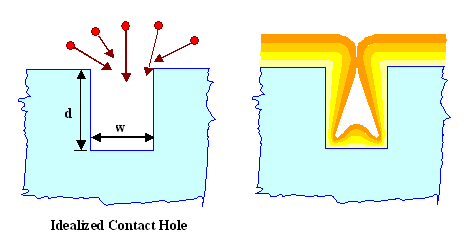
Many Al
atoms hitting the substrate under an oblique angle, will not be able to reach the bottom of a contact hole which thus
will have less Al deposited as the substrate surface. |
|
|
To make it even worse, the layer at the edge of the contact hole tends to be especially thick,
reducing the opening of the hole disproportionately and thus allowing even less Al atoms to bottom of the hole. What
happens is illustrated below. |
|
|
|
|
Fort aspect ratios A = w/d smaller than approximately 1,
the layer at the edge of the contact hole will become unacceptably thin or will even be non-existing - the contact to the
underlying structure is not established. |
|
|
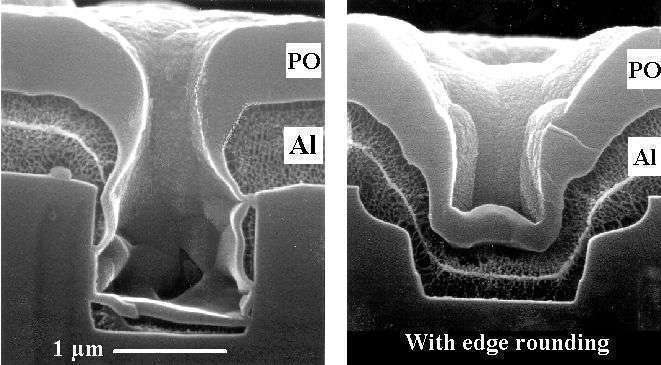
The real thing together with one way to overcome the problem is shown below (the example is
from the 4Mbit DRAM generation, around 1988). |
| |
|
|
|
PO
denotes "Plasma oxide", referring to a PECVD
deposition technique for an oxide. This layer is needed for preparation purposes (the upper Al edge would otherwise
not be clearly visible) |
|
Clearly, the Al layer is interrupted in the contact hole on the left. Al
sputter deposition cannot be used anymore without "tricks". |
|
|
One possible trick is shown on the right: The edges of the contact hole were "rounded".
"Edge rounding", while not easy to do and consuming some valuable "real
estate" on the chip, saved the day for the at or just below the 1µm design rules. |
|
|
But eventually, the end of sputtering for the 1st metallization layer was unavoidable
- despite valiant efforts of sputter equipment companies and IC manufacturers to come up with some modified and better
processes - and a totally new technology was necessary |
|
This was Tungsten CVD
just for filling the contact hole with a metal. |
|
|
In some added process modules, the wafer was first covered with tungsten until the contact
holes were filled (cf. the drawing in the CVD module). After that, the
tungsten on the substrate was polished off so that only filled contact holes remained. |
|
|
After that, Al could be deposited as before. |
|
However, depositing W
directly on Si produced some new problems; related to interdiffusion of Si and W. |
|
|
The solution was to have an intermediary diffusion
barrier layer (which was, for different reasons, already employed in some cases with a traditional Al metallization). |
|
|
Often, this diffusion barrier layer consisted of a thin TiSi2/Ti /TiN layer
sequence. The TiSi2 formed directly as soon as Ti was deposited (by sputtering, which was still
good enough for a very thin coating), the Titanium Nitride was formed by a reactive sputtering process. |
|
|
Reactive sputtering in this case simply means that some N2 was admitted
into the sputter chamber which reacts immediately with freshly formed (and extremely reactive) Ti to TiN. |
|
A typical contact to lets say p-type Si now consisted of a p-Si/p+-Si/TiSi2/Ti/TiN/W/Al
stack, which opened a new can of worms with regard to contact reliability. Just imagine the many possibilities of forming
all kinds of compounds by interdiffusion of whatever over the years. |
|
|
But here we stop. Simply because meanwhile (i.e. 2001), contacts are even more complicated,
employing Cu (deposited galvanically after a thin Cu layer necessary for electrical contact has been sputter
deposited), various barrier layers, possibly still W, and whatnot. |
|
|
So: Do look at a modern chip with some awe and remember:
We are talking electronic materials here! |
|
|
|
© H. Föll (Electronic Materials - Script)