|
Luminescence is the word for
light emission after some energy was deposited in the material. |
|
 |
Photoluminescence describes light emission stimulated by exposing the material to
light – by necessity with a higher energy than the energy of the luminescence
light. Photoluminescence is also called fluorescence if the emission happens less than
about 1 µs after the excitation, and phosphorescence if it takes long times
– up to hours and days – for the emission. |
|
|
Cathodoluminescence describes excitation by energy-rich
electrons, chemoluminescence provides the necessary
energy by chemical reactions. |
|
|
Here we are interested in electroluminescence, in
particular in injection luminescence. |
|
Injection luminescence
occurs if surplus carriers are injected into a semiconductor which then recombine
via a radiative channel. |
|
|
This implies non-equilibrium, i.e. ne
· nh > ni2 and net recombination rates
U given by the basic equation from the recombination
theory for direct semiconductors: |
|
|
|
U = R – Gtherm = r · (ne · nh
– ni2) = r · ni2 · |
æ
ç
è |
exp |
EFe – EFh
kT |
– 1 |
ö
÷
ø |
|
|
|
|
Some, but not necessarily all of the recombination events described by U produce
light, and these radiative recombination channels are of particular interest for optoelectronics. |
|
Since optoelectronic devices usually are made to produce plenty
of light, the deviation of the carrier densities from equilibrium must be large to obtain large values of U. |
|
|
If we write the densities, as before, as ne,h = ne,h(equ)
+ Dne,h, we now may use the simplest possible
approximation called high injection approximation: |
| |
|
|
|
i.e. the minority carrier density is far above equilibrium. |
|
|
That is different from the approximation made
before, where we assumed that Dne,h was small. |
|
The surplus carriers contained in Dne,h
are always injected into the volume under consideration (called recombination zone or recombination volume), usually by forward
currents across a junction. They always must come in equal numbers, i.e. in pairs to maintain charge neutrality; otherwise
large electrical fields would be generated that would restore neutrality. We thus have |
| |
|
|
|
The recombination volume usually is the space charge region of a junction or an other volume
designed to have low carrier densities in equilibrium. Since the equilibrium density
of both carrier types in the SCR is automatically very low, we may easily reach the high injection case. For a bulk
piece of a (doped) semiconductor this is much more difficult – you would have to illuminate with extremely high intensity
to increase the minority carrier density by some factor. |
|
The surplus density of carriers decays with a characteristic lifetime t which is given by the individual life times of all recombination channels open to the carriers.
Since R >> Gtherm
for the high injection case, we have in analogy
to the approximation made for (small) deviations from equilibrium: |
| |
|
|
|
We call this approximation (where we neglect G) "high-injection
" approximation or the high injection case because the high density of surplus
carriers is usually provided by injecting them over a forwardly biased junction into the region of interest. |
|
|
Note that while the rate equations are formally the same for high or low
injection (or everything in between), t is not a constant but may depend on the degree
of injection (as we will see). |
| |
Now we have to look at all the possibilities for recombination – called
recombination channels – that are open for carriers as possible ways back
to equilibrium. Recombination channels generating light we will call radiative channels. |
|
The band-band recombination channel
(with which we started above, using the full equations) can now be extremely simplified: |
| |
|
|
|
or, considering that v · s may no longer be totally
correct as the proportionality factor, |
|
|
|
|
|
and the index "b-b " denotes band-band recombination. The proportionality
constant B is occasionally called a recombination coefficient. |
|
If we use the same approximations for the recombination channel via deep levels,
we obtain a rather simple relation, too, for the recombination rate Rdl |
| |
|
|
|
With Bdl = recombination coefficient for this case. |
|
Before we look at further recombination channels, we will give some thought to
the equilibrium case. |
|
|
In thermal equilibrium, we still have generation and recombination
described by the equilibrium rates Gtherm
and Rtherm and Utherm
= Gtherm – Rtherm = 0. |
|
|
Now a tough question
comes up: If recombination occurs via band-band recombination and results in the emission of a photon, does this mean that
our piece of semiconductor, just lying there, would emit photons and thus glow in the dark? |
|
|
Obviously that can not be. Energy would be transported out of the semiconductor which means
it would become cooler just lying there, a clear violation of the "second law". On the other hand, a single recombination
event "does not know" if it belongs to equilibrium or non-equilibrium, so radiation must be produced, even in
equilibrium. We seem to have a paradox . |
|
The apparent paradox becomes solved as soon as we consider that any piece of a
material "glows" in the dark (or in the bright) because it emits and absorbs radiation leading to an equilibrium
distribution of radiation intensity versus wave length – the famous "black
body" radiation of Max Planck. |
|
|
Recombination events in equilibrium do produce light – but the photons mostly will become
reabsorbed and, in general, will not leave the material. The small amount that does escape to the environment must be exactly
balanced by electromagnetic radiation absorbed from the environment. |
|
|
This topic will be considered in more detail
in an advanced module. |
| |
|
|
Additional Recombination Channels |
| | |
|
So far we considered only band-band recombination and recombination via deep levels.
There are, however, more recombination channels, some of which are particular to compound semiconductors. |
|
But first we look at universal mechanisms occurring in all semiconductors. They
are: |
|
|
Auger
recombination. In this case the energy of the recombination event is transferred
to another electron in the conduction band, which then looses its surplus energy by "thermalization", i.e. by
transferring it to the phonons of the lattice. This means that no light is produced. |
|
|
Donor–acceptor recombination or recombination via "shallow
levels". This includes transitions from a donor level to an acceptor level or to the valence band, and transitions
form the conduction band to an acceptor level. |
|
|
Mixed forms: From a donor level via a deep level to the valence band, etc. |
|
Now for material specific recombination channels. The
most important one with direct technical uses is recombination via "localized excitons". |
|
|
Excitons are something like hydrogen atoms
(or, even closer in similarity, positronium = atom consisting of electron and positron) – except that a hole
and not a proton is the partner of the electron. They are thus electron–hole pairs bound by electrostatic interaction.
They can form in any semiconductor, are mobile and do not live very long at room temperature because their binding energy
is very small. They decompose ("get ionized") into a free electron and a free hole. |
|
|
If you wonder why they do not simply recombine, think about it. They can't possibly have the
same wave vector (how would they "circle" each other then?) and thus need a third partner for the recombination
process to occur. |
|
|
On occasion, however, they might become trapped at certain
lattice defects and then recombine, emitting light. GaP, though an indirect semiconductor,
can be made to emit light by enforcing this mechanism. |
|
|
We will come back to excitons later; more about them can be found in an advanced
module. |
| |
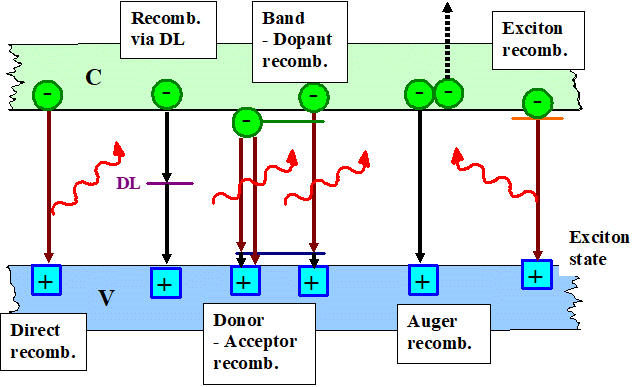
The picture below illustrates these points. |
| |
|
|
The picture is far too simple and we will have to consider some of the processes
in more detail later (especially recombination via excitons). Here we look at Auger recombination and donor–acceptor
recombination. |
|
|
Even without going into details, it is rather clear that (radiative) donor–acceptor
recombination as well as band–dopant recombination (in both variants) are not all that different from direct (and
radiative) band–band recombination. Especially for relatively high doping densities, when the individual energy levels
from the doping atoms overlap forming a small band in the band gap, we might simply add the dopant states to the states
in the conduction or valence band, respectively. |
|
|
We then can treat donor-acceptor recombination as subsets of the band-band recombination,
possibly adjusting the recombination coefficient
Bb-b somewhat. |
|
This leaves us with Auger recombination.
This is an important recombination process that cannot be avoided and that always reduces the quantum
yield of radiation production. |
|
|
It has not been covered in the treatment
of recombination before, and we will not attempt a formal treatment here. It is, however, simple to understand in the
context of the high-injection approximation used for optoelectronics. |
|
|
Since you need three carriers at the same
time at the same place (the e– and h+
that recombine plus a third carrier to remove the energy), the Auger recombination rate, RA, is
proportional to the third power of the carrier density n: |
| |
|
|
|
This means that for large carrier densities n (always way above equilibrium),
and therefore large doping, Auger recombination sooner or later will be the dominating process, hence limiting the yield
of radiative transitions. |
| |
|
|
Total Recombination and Quantum Yield |
| | |
|
All recombination processes will occur independently and the total recombination
rate will be determined by the combination of all channels. |
|
|
The situation is totally analogous to the flow of current through several resistors switched
in parallel. The individual recombination rates Ri add up (like the currents) and for the total
recombination rate we have |
| |
| Rtotal |
= |
Si
|
Ri |
= |
S i |
| n
ti |
= n · |
S
i | |
1
ti |
|
|
|
|
The total recombination time ttotal
is thus defined by |
| |
1
ttotal | = |
1
tb-b | + |
1
tdl | + |
1
tA | + |
1
texciton
| + ..... |
|
|
|
|
Since we are only interested in radiative and non-radiative channels, we may write this as |
| |
1
ttotal | = |
1
trad
| + |
1
tnon-rad
|
|
Rtotal = Rrad + Rnon-rad =
| n
trad | + |
n
tnon-rad |
|
|
|
The quantum efficiency
hqu introduced before now can be calculated. It is given by the fraction of
Rrad relative to Rtotal, or |
| | |
| |
| hqu = |
Rrad
Rtotal | = |
1/trad
1/trad + 1/tnon-rad
|
|
|
|
|
Obviously, the result is |
| |
hqu =
|
1
|
| | 1 + |
trad
t non-rad | |
|
|
|
That is easy enough, but now need some numbers for the recombination coefficients
in order to get some feeling for what is going on in different semiconductors. |
|
|
It should be clear that the Bi defined above are related to quantities
like the thermal velocity, the capture cross sections, the density of deep (and shallow) levels, and so on – they
depend to some extent on the particular circumstances of the semiconductor considered. e.g. doping, cleanliness, defect density, etc.
|
|
|
It should also be clear the Bi are not absolute constants for a
given materials but only useful as long as the approximations used are holding. in other words, there are no universal numbers
for a certain semiconductor. We only can give typical numbers. |
|
|
With this disclaimers in mind, we use the following values (if two numbers are included, they
come from different sources). Yellow denotes the indirect semiconductors and the GaP value is for the very unlikely
direct recombination without excitons. |
| |
| (T = 300K) |
Si |
Ge |
GaAs |
InP |
GaP | | B |
t [µs] |
B | t [µs] |
B | t [µs] |
B | t [µs] |
B |
t [µs] |
Bdl
[s–1] |
1 · 105 | |
| |
1 · 108 | |
| | |
|
Bb-b
[cm3s–1 ] |
1 · 10–14
1.8 · 10–15 |
5,500 | 5.3 · 10–14 |
200 |
3 · 10–10
7.2 · 10–10 |
0.015 | 1.26 · 10–9 |
0.008 | 5.4 · 105 |
2,000 |
BA
[cm6s–1] |
2 · 10–32 | |
| |
1 · 10–27 | |
| | |
|
|
|
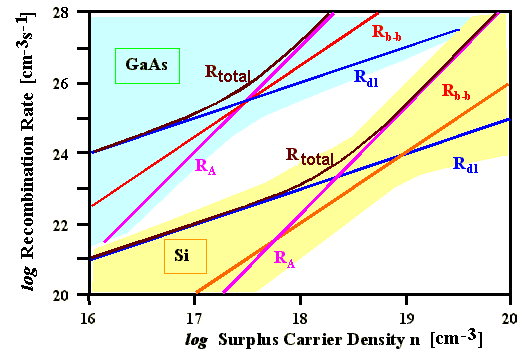
Now we can construct a recombination rate vs. surplus
carrier density diagram as follows: |
|
|
|
|
We can see a few interesting points: |
|
|
The recombination rate in Si
is generally much smaller than in GaAs – a direct effect of the much larger lifetimes. |
|
|
Direct recombination in Si is not strictly forbidden – rather, it is just unlikely.
At a typical carrier density of 1018 cm–3
we have about 1022 photons generated in Si per s and cm3
compared to about 3 · 1026 in GaAs. |
|
|
Rb-b in GaAs is similar to the recombination rates of the
Auger and deep level channels at densities around 4 · 1017 cm–3, whereas in Si,
for most densities Rb-b is much smaller than the other recombination rates. |
|
|
Although for large carrier densities the Auger recombination process always dominates, it
may still be useful to increase n: While the quantum efficiency goes down,
the amount of light produced still increases
with n. |
|
|
For very large carrier densities (say 1019 cm–3
and beyond as occasionally encountered in power circuits), even Si may produce some visible light. |
| |
The GaAs curves now provide a first answer to our second
question about the quantum efficiency. |
|
|
For n = 1016 cm–3, we have about 4 · 1022
radiative recombination events per s and cm3 out of a total of about 1024 per
s and cm3 , which gives a quantum efficiency of 4 %. |
|
|
At the high density end, around n = 1019 cm–3, the
situation is similar, the quantum efficiency is in the few percent range. |
|
|
The highest quantum efficiency is around 30 % for densities around n = 5
· 1017 cm–3. |
| |
Of course, given the values of the recombination coefficients, we could calculate
the quantum efficiency precisely, but that would not be very helpful because real devices are more sophisticated than the
simple forwardly biased junction implicitly assumed in this consideration. |
|
|
This means that we now must look more closely at the important compound semiconductors, especially
on how they are doped and what typical differences to Si occur. |
|
|
We will, however, first do a little exercise for injection across a straight p-n junction
in order to get acquainted with some real numbers for carrier densities produceable by injection. |
| |
| Exercise
5.1.2-1 |
| Calculate carrier densities from the forward current of junctions. |
|
© H. Föll (Semiconductors - Script)