 |
Essentially, we want to know the distribution of photon energies in a piece of semiconductor
with a certain volume V = L3 (for simplicity) which is in thermodynamical equilibrium at
some temperature T. Don't confuse this L with the diffusion length ! |
|  |
We solved a similar problem already when we looked at the distribution of electron
energies in a piece of semiconductor with a certain volume V = L3; i.e. when we went through
the free electron gas model. |
|
|
There is no reason why we should not follow the free electron gas model. We do not have to solve the Schrödinger
equation because we already know that photons are waves described by some exp (ik·r
– w
t) with w = 2p
n |
|
|
With that, we also know that the boundary conditions imposed by the finite crystal will only allow wave
vectors that fit into the crystal and form standing waves. |
|
All we have to do then is to figure out the density of states
at the energy hn, and the probability
fph(hn) that these states are occupied . |
| |
For the density of states we obtain exactly as in the free electron gas |
| |
|
|
|
and it has been taken into account that there are two polarization
states per photon for each k . |
|
|
Rewriting this for photon energies hn using k = 2pn ·nref /c
with nref = refractive index of the semiconductor, yields |
| |
| Dph(hn)·dn |
= |
8 · p · nref3 · (hn)2
h3 · c3 |
· d(hn) |
|
|
|
What is the probability that the states at some energy hn
are occupied? For electrons - which are Fermions - this was given by the Fermi-Dirac distribution
which made sure that only one electron could occupy a given state. |
| |
Photons, however, are bosons and any number can share
a given state. We therefore must resort to the Bose-Einstein distribution given by |
| |
| fph(hn) | = |
1
exp (hn/kT) – 1 |
|
|
|
The density
u n · dn of photons in the frequency
interval n, n + dn
(and, as always, per volume unit) is then given by the product of the density of states and the probability of occupation,
it is |
| |
| undn |
= |
p · nref3 · (hn)2
h3 · c3 · exp (hn/kT) –
1 | · d(hn) |
|
|
|
|
This is Plancks formula for the number of
photons per volume element in the energy interval hn, h n
+ d(hn) - derived in just a few easy steps! |
|
If you compare it with some text book formula, you may find a different version - different
by a factor hn! |
|
|
This is because ususally it is not the photon density, but the energy density
that is considered. The total energy contained in a volume element between , hn +
d(hn) is of course simply the number of photons with
that energy interval times their energy hn. |
|
|
The energy density, if plotted, gives the well known spectral intensity curves that made Planck famous. |
| |
|
|
If we want to know how many photons we have with the band gap energy,
we only have to insert hn = Eg to get the answer. |
| |
But how about hn = Eg/2 or any other energy inside
the band gap? After all, photons with these energies can not be created in the semiconductor, while they have a certain
density according to Plancks formula. |
|
|
Well, as in the free electron gas model (which does not have band gaps after all) we have made approximations
that do not quite apply to the case of semiconductors. We have assumed a black body
that absorbs and emits at all frequencies - and this is not
true for a "cool" semiconductor. |
|
|
Essentially, we should enter the proper density of states for photons,
but this is far beyond the scope of the course. |
|
On the other hand, we can make a detailed inspection of the the thermodynamic equilibrium just for the frequencies corresponding to the band gap. |
| |
This was what Einstein contributed to this
field (should have been his 3rd or 4th Nobelprize). It will yield expressions for the "Einstein
coefficents" crucial for Lasers and is demonstrated
in another advanced module |
|
| |
|
Finally, a few words to the reason why Plancks radiation
law was so seminal and what went wrong before it was found. |
|
|
Before Planck, others had considered radiation equilibrium - essentially people wanted to know why all hot bodies "glowed" pretty much the same way, independent of their composition. |
|
|
Based on a the "final" knowledge of electromagnetism as put down by Maxwell and a fully developed (classical) theory of thermodynamics, Raleigh and Jeans showed - beyond
a trace of doubt - that the energy density hn · un
· dn = E n · dn
of electromagnetic radiation coming off a hot body must be |
|
|
| En · dn |
= |
8 · p · nref3 · (hn)2
h3 · c3 · kT |
· d(hn ) |
|
|
|
|
Big problem! The energy density increases forever, and there should be tremendous amounts of UV
and X-rays coming out of a hot body. This is obviously not true, the term "ultraviolet
catastrophe" was coined. |
|
But Raleigh and Jeans made no mistake - something was fundamentally
wrong with classical physics as a discipline. The ultraviolet catastrophe, in fact, was one of the many stumbling boocks of classical physics at the close of the 19th
century. Let's see what went wrong: |
|
|
Essentially , Raleigh and Jeans' formula says: |
|
|
| Energy density En · dn
| = |
density of states D(E ) · kT |
|
|
|
|
This is nothing but the equipartition
theorem that states that in a given system every energetic degree of freedom is imbued with the same
average energy kT . Since the energy fluctuations - with kT
as the average value - can have any value (just with different probabilities),
all energies (= energy levels in modern parlor), including the very large ones - can
be reached and populated. |
|
The correct formula of Planck now essentially states that |
| |
Energy density Endn = density of
states D(E) times hn times distribution
function. |
|
|
Energy now comes in quanta hn, and for finite temperatures there might
not be any to populate the high-up states. |
|
|
Big difference! But not for low energies, where the Raleigh-Jeans law is a good approximation
of Plancks law. |
| |
© H. Föll (Semiconductors - Script)
 2.1.1 Essentials of the Free Electron Gas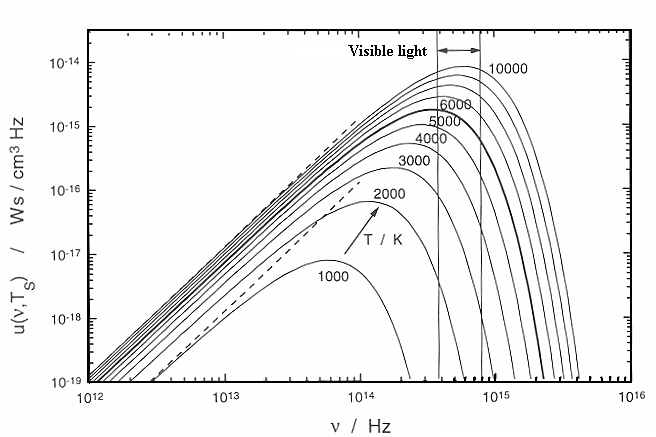
 With frame