|
All theories introduced so far (i.e. all of chapter
2), always assumed "infinite" or "semi-infinite" crystals. For example, the size of the crystals
did not matter for the characteristics of a pn-junction; the dimensions of the n- and p-doped regions
did not enter the equations. |
|
 |
However, if we reconsider for a moment the simple derivation of the I-U-characteristics
of a pn-junction, we (hopefully) remember that the carriers responsible for the reverse current originated from a
region defined by the diffusion length of the minority carriers.
|
|
|
What happens if the device is much smaller than the diffusion length L ? This will be almost
always the case, considering that L is around 100 µm and typical integrated transistor occupy
hardly 1 µm2? |
|
While this question can still be answered relatively
easily by conventional device physics, it nicely illustrates that we can not expect the properties of any
device to be independent of its size as suggested by simple semiconductor physics. |
| |
The basic question in micro-technology thus is: What happens if you make an existing (and functioning)
device smaller? |
|
|
And making something smaller can be done in different ways: You may simply decrease the lateral extensions
while leaving the depth dimension unchanged, or more realistically, you scale the lateral and depth dimensions by different
factors. As an example, while you may reduce the lateral size of a source-drain region by a factor of 2, the depth
of the pn-junctions and the thickness of the gate oxide may scale with only a factor of 1,3. |
|
|
How do you find the optimum? Where are limits and how can they be overcome? In other words: What are the
relevant scaling laws and when do we hit a brickwall - you can't make it smaller any more without insurmountable problems! |
| |
There are some billion Dollar questions hidden in this scenario, and there are no easy answers
for some of the details. There are also, however, some simple laws and rules which we will consider briefly in this subchapter. |
| | |
|
Linear Scaling and Problems |
| | |
|
Lets look at some general scaling laws. We simply
assume that we decrease all linear dimensions of an existing device by the scaling factor
K. |
|
|
A first obvious conclusion is that the field strength in some insulating layer, e.g. a gate
oxide, increases K -fold. We may accept that, or we might scale the voltage, too. In this case we would decrease
UDD, the external driving voltage, to UDD/K. |
|
|
Going through all important parameters (with some approximations if necessary), we obtain
the following table |
| |
| Property |
Scaling |
| All lateral and vertical dimensions | 1/K |
| Doping concentration | K |
| UDD Þ
UDD/K | UDD = constant |
| Packing density (No. transistor/cm2) | K2 |
K 2 | | Current densities |
K | K3 |
| Field strenghts | 1 | K |
| Power loss density | 1 | K3 |
| Power loss per transistor | 1/K2 |
K | | Time delay per transistor |
1/K | 1/K2 |
|
|
The problems you are running into are obvious. Lets look at the transition from
a 1 µm process to a 0,25 µm process, i.e. K = 4 |
|
|
Without a fourfold reduction in the supply voltage, we would have a 64
fold increase in current densities and power loss, and a 4
fold increase in field strength. This is not going to work |
|
|
Decreasing U DD fourfold (from 5 V to 1,25 V) still
increases the current density fourfold, but keeps all other parameters manageable. However, our device only speeds up 4
fold, compared to 16 fold for constant. UDD. |
| |
So simply lets scale down UDD some more? Well, yes -
but: You can't just decrease all dimensions and UDD just so! |
|
|
The tjickness of gate and capacitor dielectrics might be close to absolute limits (e.g. imposed
by tunneling) and simply cannot be scaled down much more. |
|
|
Internal voltages might only be fractions of the supply voltage and reducing UDD
may decrease signal to noise levels to unacceptable values. |
|
|
Voltage swings for switching transistor must at least be in the order of the band gap, i.e.
1 V for Si. Voltages thus cannot be reduced to arbitrarily small levels. |
|
If we look at the actual scaling of devices, much ingenuity and many additional
process steps were used to avoid the simple rules of scaling. Here are a few examples: |
|
|
Trench capacitor instead of planar capacitor. The thickness of the dielectric thus could stay
relatively constant, which allowed higher supply voltages than required by scaling. |
|
|
Electromigration resistant metallization (addition of Cu or other atoms to the Al
lines, multi layers etc.) allowed larger current densities |
|
|
"Lightly doped drain", i.e. complicated dopant profiles of the source/drain region
below the gate allowed higher field strengths in the MOS transistors. |
|
The list is easily extended by 10 or more points; but you get the drift. |
|
|
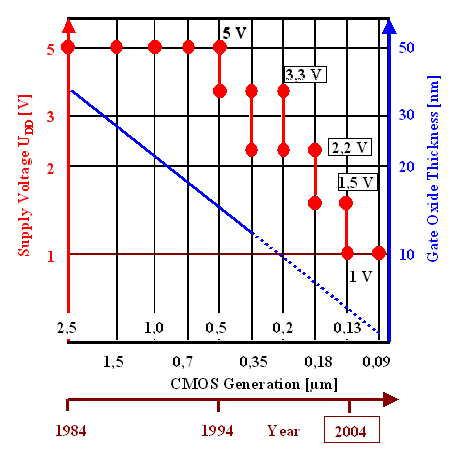
But all tricks notwithstanding: the supply voltage had to come down. The
historical development is shown in the figure below. |
|
|
|
|
There are several remarkable features: |
|
|
For almost 10 years the supply voltage was kept constant at UDD
= 5 V despite a scaling of K = 5. This was possible by a dramatic increase of process complexity and materials
engineering. |
|
|
The end in scaling UDD is near. Now (2001), supply voltages
are as low as 1, 5 V, and we simply cannot go much below 1 V with Si. |
|
|
New principles are needed, because we still can make functioning transistors far below 0,1
µm. One possible solution is to make vertical transistors. Demonstrators (Bell Labs) work with gate length of 30
nm or less. |
|
What happens: You will not only live to see it, but possibly help to establish
it. |
| |
|
Fundamental Limits |
| | |
|
Whatever clever tricks are used to make just one more step towards smaller devices,
there are some ultimate limits. One simple example shall be given; it concerns doping: |
|
|
Lets say we need doped areas with a typical dopant concentrations of r
= 1016 cm–3
or 1018 cm–3 and maximum deviations of ± 10%. This implies that
the doped area must contain at least 100 dopant atoms because the statistical fluctuations are then (100)1/2
= 10 giving the 10% allowed. |
|
|
100 atoms at the prescribed density need a volume of (100/1016) cm3
or (100/1018) cm3
, respectively, which equals 107 nm3 or 105 nm3, respectively. |
|
|
These volumes correspond to cubes with a linear dimension of 215 nm or 46,4 nm,
respectively. What does this mean? |
|
Look at it in a different way: A typical source/drain region in a modern integrated
circuit may be 0,5 µm x 0,5µm x 0,2 µm = 5 · 10–2 µm3 = 5 ·
107 nm3. |
|
|
At a doping level of 1016
cm3 - corresponding to the perfectly reasonable
resistivity of 1.4 Wcm (p-type) or 0.5 Wcm (n-type)
- we have about 500 doping atoms in there! Doping to a precision better than (500)1/2 = 22,4 or 4,47
% is principially not possible assuming a statistical distribution of the doping atoms. |
|
|
Decreasing the size to e.g. 0,1 µm x 0,1µm x 0,02 µm = 2 · 105
nm3 leaves us 2 doping atoms in there - obviously absurd. Again we have to turn to novel structure
- vertical transistors may do the trick once more. |
|
There are more "fundamental limits" - just how fundamental they are,
is a matter of present day research (and a seminar topic). |
| |
|
© H. Föll (Semiconductors - Script)