|
First, we must realize that the surface is a defect
– beyond it, there is no periodic lattice anymore; the bonds of the surface atoms have some other arrangements than
the bonds in the bulk. |
|
 |
The dispersion relation of electrons in the two-dimensional surface "crystal"
thus must be expected to be different from that of the bulk. |
|
|
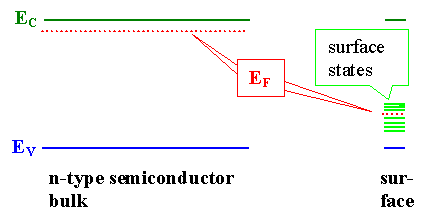
In the simplest approximation conceivable, we may picture the surface with the same band diagram
as the bulk (but in only two spacial dimensions), but with plenty of additional states in the band gap. |
|
We have then the following representation: |
| |
|
|
|
The surface introduces some unspecified states in the band gap of an n-type semiconductor,
shown here arbitrarily as acceptor states. The Fermi energy will adjust itself as shown: Since states in the bandgap are
available that are lower than the donor states (not shown for graphic simplicity), electrons will move down to these states
– so the Fermi energy also comes down. |
|
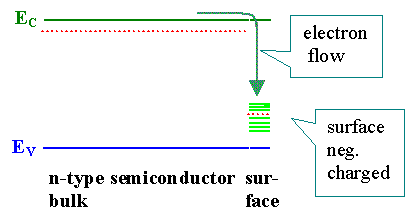
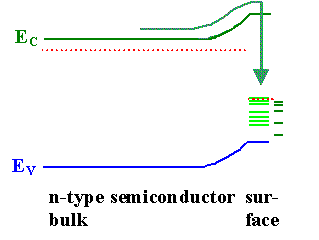
We will now consider what would be happening if we were to bring the bulk and
the surface in close contact. Shown here are three graphical representations of this (fictitious!)
process: |
|
|
Upon contacting, the electrons from the conduction band of the bulk will flow to the still
empty states of the surface. This will put an additional negative charge at the surface. (Note that before that, the surface
was not charged.) |
| |
|
|
|
In response to the negative surface charge, the electrostatic potential at the
surface goes up and extends (decreasingly) into the bulk – we have an internal potential
V(x). The simplest way to visualize the band bending going with this
potential is to remember that the electrons from the bulk are repelled by the negative surface charge. Since work is needed
to move them to the surface, this is an "uphill" process. (Remember that the band diagram gives the energy of
the electrons.) |
| |
|
|
|
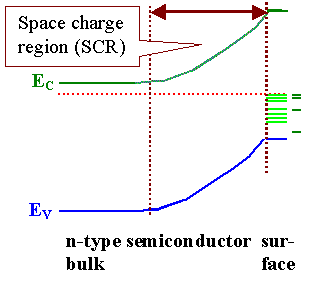
As long as the total energy can be reduced by moving electrons from the bulk to
the surface, the process will continue. (Remember that energy minimization is the way towards equilibrium.) Equilibrium
is reached as soon as it makes no difference any more if one more electron is in the bulk or on the surface, i.e., if we
change the electron amount by Dne. This means that equilibrium is given
by 0 = dG = (¶G/¶ne)bulk
· Dne(bulk) + (¶G/¶ne)surface
· Dne(surface). |
| |
|
|
|
From the obvious relation Dne(bulk) = –Dne(surface) it follows that in equilibrium, we have (¶G/¶ne)bulk = (¶G/¶ne)surface. Since (¶G/¶ne) = chemical potential µ = Fermi energy EF,
this means that: |
|
|
|
The Space Charge Region |
| | |
|
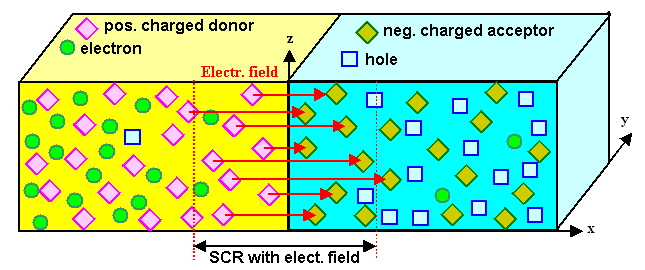
The easiest way to think about this electrical field is to consider the field lines, which start at a positive charge and end at a negative charge. |
|
|
The negative charges are the surplus electrons sitting in the surface states
(and thus also in real space at the surface), the positive charges are the "ionized"
donor atoms in the bulk. |
|
|
This view immediately leads to a "quick and dirty" formula for the width d
of the space charge region: We consider the capacitance
CSCR of the SCR. |
|
|
Since the positive charges are spread homogeneously through the volume of the SCR,
we approximate the capacity of the SCR by a plate capacitor with half the distance
d between the plates, i.e., dcap = d/2. In other words, we sort
of put all the positive charge on a fictitious plate at half the width of the SCR. |
|
|
The capacitance then becomes |
|
|
| CSCR = |
2 er · e0
· A
d |
= | Q
U |
|
|
|
|
With A = area of the capacitor plates, Q
= charge on the plates and U = potential difference between the plates. |
|
|
The charge on the plates is equal to the number of ionized donors in the volume of the SCR.
The volume is d · A and the number of charges is just the density of donors ND
(assuming that all are ionized) times the elementary charge e times the volume d · A, so we have
|
| |
|
|
|
Substituting this in the equation from above, we obtain |
| |
2 er · e0 · A
d | = |
e · ND · d · A
U |
|
|
|
This gives us one of the more important semiconductor device equations in its
simplest form – and this is the correct equation despite the somewhat questionable
assumption of dcap = d/2: |
| |
| d | = |
æ
ç
è |
2 er e0
Ubi
e ND
|
ö
÷
ø | 1/2 |
|
|
|
The voltage Ubi is the difference of
the values of the internal potential between the bulk and the surface; it is called the built-in
potential. Here, of course, it is simply the difference of the Fermi energies expressed as a potential, i.e. |
| |
|
|
|
We immediately can generalize: If, in addition to the "built-in" potential DEF/e, an additional external potential Uex is added
from the outside by simply connecting the material to a voltage source at Uex, the total voltage
becomes U = DEF/e + Uex, and the width of the
space charge region is |
| |
| d | = |
1
e | · |
æ
ç
è |
2 er · e0 · (DEF + e · Uex)
ND | ö
÷
ø |
1/2 |
|
|
|
|
Note that, since the built-in potential Ubi is taken to be positive,
a positive Uex will increase the width of the space charge region – by increasing the potential
difference between bulk and surface. |
|
It is easy to to obtain the same
equation by integrating the Poisson
equation for this case. This is done in an illustration module. |
|
|
This example illustrates nicely the approach we take in this chapter: We start from the most
simple consideration of the case and try to deduce proper relations and formula by analogies – cutting corners a little
if necessary (but only as long the results are still correct). |
| | |
|
"Ideal" p–n Junction |
| | |
|
We now construct a p–n junction exactly along the recipe given above: |
|
|
Draw the band diagrams of both parts. |
|
|
Join the two parts, move electrons to the materials with the lower Fermi energy, holes opposite. |
|
|
Build up space charges and shift the potentials accordingly until the Fermi
energy is the same everywhere. |
| |
These steps are illustrated below: |
| |
|
|
|
As a graphical aid, which will be useful in cases to come, the carriers are schematically
indicated as circles (electrons) and squares (holes). Many such symbols being present is meant as an indication for majority
carriers, whereas few ones being present indicates the minorities. |
|
The only differences to the first situation is that we now have a space charge
region on both sides of the junction. |
|
|
The field lines are now pointing from the positively charged donors on the n-type side
to the negatively charged acceptors on the p-doped side. |
|
|
The width of the space charge region is now a
little more involved to calculate (but there is nothing new); it comes out to |
| |
| d = |
1
e |
· |
æ
ç
è |
2 · er · e0 ·
| æ
è |
1
NA
|
+ |
1
ND
|
ö
ø |
· |
æ
è |
DEF |
+ e · Uex |
ö
ø |
ö
÷
ø | 1/2 |
|
|
|
Now let's look at the various currents flowing
in the conduction and valence bands without an external voltage. |
|
|
We know that the net current is zero – we are in an equilibrium condition as long as
we do not apply an external voltage (or shine some light on it). |
|
|
We also know that we have a dynamic equilibrium
as in the case of the recombination/generation business before. The net current is zero because the local currents cancel
each other. This implies that the electron current flowing uphill (from left to right) is identical in magnitude and opposite
in sign to the one flowing from right to left (downhill). |
|
|
The same reasoning applies, of course, to the holes in the valence band. |
|
The partial currents discerned above have several specific names. The current
component flowing uphill in energy is called . . . |
|
|
Diffusion current, because the driving
force behind this current is the density gradient in the carrier density. This always leads to a current component given
by Fick's first law to |
| |
|
|
|
With n
= density of the carriers in question. (The electric charge e has to be given explicitly in this equation
because n only gives the number of particles present.) |
|
|
It is also alternatively called recombination
current because all the electrons (or holes) flowing to the other side become excess minority carriers there and
must disappear by recombination, which can be depicted as a current flowing between the bands. |
|
|
Looking a little ahead, a p–n junction is a diode and currents in diodes are
classified as either forward or reverse current. Well, the current component in question here is responsible for the forward current in the diode and therefore is also addressed under that
name. We will use mostly this name and abbreviate this current component with jF. |
| |
The partial current flowing downhill in energy is called . . .
|
|
|
Field current, because it is the current
that the electrical field in the junction produces; i.e. the carriers flow in the general direction of the field lines with
the respective proper signs. The diffusion current, in contrast, flows against the force exerted by the field (which will
slow down these carriers!) |
|
|
Drift current, because it is the current
that results from a drift – caused by the electrical field – superimposed on random diffusion movements. |
|
|
Generation current, because the
(minority) carriers that were swept down the energy hill (or up in the case of the holes) get replaced by increased generation,
thereby keeping the density constant. |
|
|
Reverse current in the diode nomenclature
explained above. We will use mostly this name and abbreviate this current component with jR. |
| |
|
|
Simple Current–Voltage Characteristics |
| | |
|
In equilibrium, without an external voltage Uex and without
illumination, we know that the net current is zero, or |
|
|
jF = –jR, or, to be more precise,
|
| |
|
|
To make life a little easier, we now drop some matter-of-course indices, and the signs; i.e. we only look at the magnitudes of the current components.
It is easy enough to sort out the signs in the end again; in case of doubt refer to the link.
In this shorthand notation we have |
|
|
|
|
|
If we draw these currents schematically into the band diagram from above, it looks like this: |
| |
|
|
|
Of course, the currents do not flow on both sides of the band edge; this is simply a drawing
means. |
|
What happens for finite external voltages? First let's look at the band diagrams: |
|
|
An external potential Uex is added, which will raise or lower the
equilibrium potential, depending on its sign; for sake of simplicity we only move the p-side band diagram. But do
we have to move it up or down? |
|
|
It depends: We have two possibilities for choosing the polarity of the external voltage, either
increasing the already existing electrical field or weakening it. (Remember that the field lines are pointing from the n-side
to the p-side; if you have forgotten why this is so, look again at the explanation given above.) |
|
|
Thus, the potential on the p-side goes up
for the negative pole of the voltage supply on the p-side (always think about if electrons are repelled or attracted
if you are unsure about how a potential moves bands), and down for the positive pole
on the p-side. |
|
|
We no longer have an equilibrium situation – the Fermi energy is no
longer the same everywhere; we must leave it undefined across the junction. (Later on we will have a look at how the Fermi
energy behaves inside the SCR.) |
|
|
Far away from the junction, however, nothing (or very little) has changed. We still may consider
these parts of the semiconductor to be in equilibrium (or at least very close to it). |
|
The band diagram for the two possible basic cases then look like this: |
| |
|
|
|
The diffusion currents are shown increased (thicker arrow) if the energy barrier was lowered,
and decreased if it was raised. The drift currents are unchanged. |
|
The situation now is rather simple. The potential step is either
increased or decreased. Let's first look what happens to the forward currents
jF(Uex). |
|
|
At
zero volts the electron and hole forward currents have a certain value that is certainly determined by the height of
the energy barrier that the carriers have to overcome, following
Boltzmann statistics (as an approximation to the Fermi statistics, of course). |
|
|
In other words, the equation for this current includes an exp[–E/(kT)]
term. Changing the energy barrier E by D
E simply means to multiply the current at zero volts with exp[–DE/(kT)]. |
|
|
Since the magnitude of jF for zero external voltage is just jR(Uex=0),
the forward current current jF(Uex) at any
voltage Uex is (and this is true both for the electron and the hole forward current)
|
| |
| jF(Uex) | = |
jR(Uex=0) · exp |
æ
è | – |
DE
kT |
ö
ø | = |
jR(Uex=0) · exp |
æ
è | – |
e · Uex
kT |
ö
ø |
|
|
|
|
Note that, due to the minus sign in the exponent (which we inherited from the Boltzmann distribution),
increasing the energy barrier leads to a decrease of the forward current; we will come back to this later. |
|
|
Imagine this as a lot of (drunken) bicyclists with various random momentums driving around
randomly at the foot of a hill. Some of them on occasion will make it up the hill because their momentum was large enough
and they were heading in the right direction. The fraction of bicyclists making it will simply change exponentially with
the Boltzmann factor relative to their "current" at some reference value if the hill is raised or lowered. |
|
Now to the reverse current
jR(Uex). |
|
|
It corresponds to (drunken = randomly moving) bicyclists that drive around for a certain
time (corresponding to the life time of the minority carriers) on the plateau on top of the hill before falling off their
bikes (recombining). |
|
|
However, everybody who by accident makes it to the edge of the hill will invariably careen
down, i.e., produce a reverse current. |
|
|
Clearly, it only matters how many carriers happen to make it to the edge of the potential
drop, not how deep it is. In other words: The reverse current does not depend on the external voltage,
or |
| |
|
|
The total current is simply the difference
between forward and reverse current for the electrons and the holes, so we have |
| | |
| j(Uex) | = |
æ
è |
jF(Uex) – jR |
ö
ø | e
| + | æ
è
|
jF(Uex) – jR |
ö
ø | h |
| | | |
| | |
| | |
| |
| j(Uex) | = |
æ
è |
jRe + jRh |
ö
ø | · |
æ
ç
è | exp |
æ
è | – |
e · Uex
kT |
ö
ø | – 1
| ö
÷
ø |
|
|
|
|
Note that we did not assume that the forward
or reverse current of the holes must be identical to the forward or reverse current of the electrons, respectively. Of course,
if everything were symmetrical, we would have jRe = jRh,
but we want to keep it a as general as possible even at that level since many real devices employ wildly different electron
and hole currents across the junction. |
|
This is the famous diode equation,
and this is all there is to it for straight-forward p–n junctions – except that the technically relevant
diode voltage UD, being related to the technical current flow direction, is taken as positive
for the current flowing in forward direction; thus, we have UD = –Uex
. |
|
|
This just means that, in order to make the forward current flowing, the external
voltage must be applied such that it effectively reduces the built-in potential difference. |
|
Combining the reverse currents of electrons and holes in a single constant j0
:= jRe + jRh, we arrive at the final form of the ideal diode equation:
|
| | |
| j(UD) | = |
j0 · |
æ
ç
è | exp |
æ
è |
e · UD
kT |
ö
ø | – 1
| ö
÷
ø |
|
|
|
All that is left to do is to consider the reverse currents j0 a bit more closely.
|
|
|
Thinking again about drunken bicyclists, but now driving around on the top of the hill (and
thus representing electrons), we might be tempted to assume that jRe should be proportional to their numbers, i.e., to the minority carrier density
on the plateau. |
|
This, however, is wrong.
|
|
|
So let's sober up and think a bit harder: You only can extract the bicyclists once!
Yet if you want a constant current over time, the best you can do is to take all carriers
for the current that are (i) generated per time unit and (ii) making it to the edge.
|
|
|
In other words, you need to refill the ranks of bicyclists
and the current will be proportional to the generation rate G (to what comes
out of the bars per time interval), which we know is equal to the
recombination rate R in undisturbed semiconductors and given
by |
| |
| G | = R = |
nmin
t |
= | ni2
t · NDop |
|
|
|
|
With t = lifetime. |
|
This is a remarkable achievement – obtained without involved calculations
and cutting corners only once (proportionality const. =
1). But how good is it? Only the experiment can tell. |
|
|
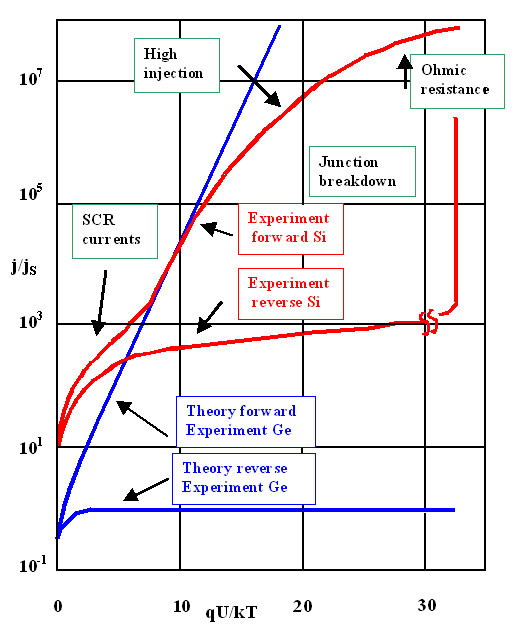
If we measure the current–voltage characteristic of an
"ideal" p–n junction, we will find the following curves: |
| |
|
|
|
Generally, for Ge (or other semiconductors with relatively small band gaps) the measured
characteristics is remarkably close to the one predicted by our formula. For Si, however (and other semiconductors
with large band gaps), it is not a good formula, particularly for for the reverse current.
We have large deviations from theory, labeled with black lettering. So, let's see what went wrong (more
details in the link) in each case. |
|
First, our theory has the usual (trivial)
omissions. We did not include any ohmic resistance which can be easily added by putting a resistor in series to the junction.
The result is the ohmic behavior for larger voltages as seen at larger currents. |
|
Second, everything will break down
at high field strength; this is true for a junction, too. So for large reverse voltages (easily in the range 100 V .
. . 1,000 V), the junction will go up in smoke while drawing a large current called "junction breakdown". |
|
|
While these points would apply to a Ge junction too (they are not shown in the ideal
characteristics), the remaining deviations for Si involve a major oversight in our present theory: |
|
Third: We did not include
carrier generation (and recombination) in the space charge region! |
|
|
In the bicyclist picture, we did not take into account that there are bars along the slope
of the hill, too, which will emit bicyclists with a certain momentum and direction – they may either go up or down
the hill and thus add to the current of particles moving in either direction. |
|
|
This adds four more current components (forward and reverse for holes and electrons) summarily
called generation currents from the SCR. |
|
How large are these SCR-caused current components? |
|
|
The answer comes from one of the more involved problems in semiconductor physics, it is not
easy to obtain for real semiconductors (we will do it later). However, there
is an easy way of thinking about it that even comes up with the usually given formula
resulting from serious (but still approximate) computing. But we sure will have to cut a few corners! |
|
|
Here we go: |
|
| |
|
Current–Voltage Characteristics with
Generation Currents from the Space Charge Region |
| | |
|
We know the maximum current jmax that could emerge from
the space charge region: It is the generation rate of carriers times the width of the SCR in complete analogy to
the discussion above. More than that cannot flow out (in one direction for the maximum) per unit time.
|
|
|
Every generation event produces a hole and an electron, so we have |
| |
|
|
|
With d = width of the SCR, and GSCR =
generation rate inside the space charge region. |
|
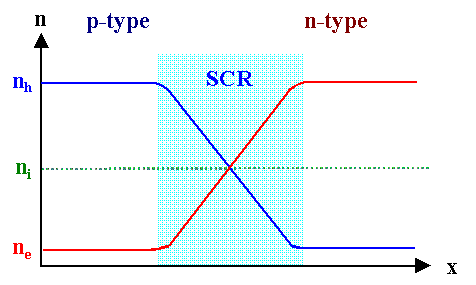
How large is GSCR? This needs to be
considered in detail since it wouldn't help to simply use the known equation G = nmin/t, because nmin is not constant across
the SCR; very schematically, it rather looks like this: |
| |
|
|
Inside the SCR, this makes G a strong function of x
– how are we going to handle this? |
|
|
Well, let's take a kind of average value for the carrier
density, and what suggests itself is the
intrinsic carrier density ni, which is the value at the point where the two curves cross
each other because of the mass action law stating ne ·
nh = ni2. |
|
|
Within this (questionable!) approximation the maximum current generated in the SCR then becomes
|
| |
|
|
And we know more: If the external voltage is zero, the total current is zero and
this means that half of the SCR current must be forward and the other half reverse. We have |
| |
| jF(0) | = |
jR(0) | = |
e · ni · d
t |
|
|
|
If we now change the barrier height by eUex, the forward
current will change as before. However, we cannot simply multiply by exp[–eUex/(kT)]
as before! |
|
|
While a carrier generated at the bottom of the hill experiences the full added potential,
a carrier generated further up sees less or even no potential if it originates all the way uphill. |
|
|
So again, let's be sloppy and assume an average additional
energy barrier, average between everything and nothing – and this will be eUex/2. |
|
|
Again assuming that jR does not depend on the barrier height (but slightly on U since the width d of the SCR
is voltage dependent), this gives us: |
|
|
| jF(Uex) = |
e · ni · d
t |
· exp |
æ
è |
– | eUex
2kT |
ö
ø |
|
|
|
|
The two components no longer add up to jmax, but we don't have to
worry about this. We only would be very wrong for large
forward currents, but in this case the bulk forward current is always much larger
anyway – so it does not really matter much for the diode behavior. |
|
The total current from the space charge region then becomes
jSCR = jF – jR. Written out and, as above,
using UD = –Uex, we have |
| |
| jSCR(UD) | = |
e · ni · d
t | · |
æ
ç
è | exp |
æ
è |
eUD
2kT |
ö
ø |
– 1 |
ö
÷
ø |
|
|
|
|
This happens to be exactly the same formula
(give or take a factor of 2) that we would obtain with the
"proper" theory. |
|
|
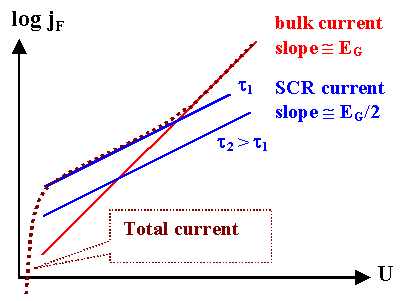
We may use the same abbreviation for the bulk reverse current as above and additionally
abbreviate the SCR one in a similar manner, then we see more clearly that we effectively have two diodes parallel, the first
(prefactor j01) representing the bulk currents and the second (prefactor j02)
representing the SCR currents: |
| |
|
| j(UD) | = |
j01 · |
æ
ç
è | exp |
æ
è |
e · UD
kT |
ö
ø | – 1
| ö
÷
ø |
+ | j02 · |
æ
ç
è | exp |
æ
è |
e · UD
2kT |
ö
ø | – 1
| ö
÷
ø |
|
|
|
Let's see what it means in forward direction: |
|
|
We may neglect the –1 in the SCR part of the forward current; it then
adds a component that increases with exp[eUD /(2kT)], i.e.,
with half the slope of the bulk current (in an Arrhenius diagram). The half-slope component
will always "win" at small voltages but pale to insignificance at higher voltages as shown in the illustration: |
| |
|
|
|
The combined characteristic looks very much like the measured behavior shown above; the sharp
drop of the current close to U = 0 V is due to the –1 in the diode equation (i.e.,
the reverse current jR) which we neglected for larger voltages. |
|
|
We also see that the exact value of the SCR
forward current indeed only matters for small voltages, as claimed above. |
|
What do we get in reverse direction? |
|
|
First, the reverse current now is voltage dependent because
the width of the space charge region and thus jR increases with a U1/2
law. |
|
|
Second, the total reverse current now is larger. Assuming
a symmetric junction (ND = NA = NDop) and identical life times
(and so on) for electrons and holes, it is easy to calculate the relation jR(bulk) / jR(SCR);
we have |
| |
jR(bulk)
jR(SCR)
| = |
| = | L
· ni
NDop · d |
|
|
|
|
|
|
The decisive factor is ni. It decreases exponentially
with increasing band gap Eg. |
|
|
This answers the question why Ge junctions follow the simple theory, while Si
junctions are far off: If ni >> NDop, then jR(bulk)
>> jR(SCR) and the SCR contribution will not be felt. |
|
|
The generation current from the SCR thus is much more important in semiconductors with
larger band gaps. The characteristics from above show this rather clearly. |
|
|
Whereas the SCR part may be safely neglected for Ge (Eg = 0.6
eV), it is about (102 . . . 103) times larger than the bulk diffusion current in Si. |
|
|
The SCR currents should be absolutely dominating
in large band-gap semiconductors. Not only is ni rather small, but L = (Dt)1/2 is very small, too, since these materials are often direct semiconductors.
|
© H. Föll (Semiconductors - Script)