|
We are not very particularly interested in bipolar transistors and therefore will treat them only cursory. |
|
 |
Essentially, we have two junctions diodes switched in series (sharing one doped
piece of Si), i.e. a npn or a pnp configuration, with the added condition
that the middle piece (the base) is very thin.
"Very thin" means that the base width dbase is much smaller than the diffusion length
L. |
|
The other two doped regions are called the emitter
and the collector. |
|
|
For transistor operation, we switch the emitter - base (EB) diode in forward direction,
and the base - collector (BC) diode in reverse direction as shown below. |
|
|
This will give us a large forward current and a small reverse current - which we will simply
neglect at present - in the EB diode, exactly as described for diodes.
What happens in the BC diode is more complicated and constitutes the principle of the transistor. |
|
|
In other words, in a pnp transistor, we are injecting a lot of holes into the base
from the emitter side, and a lot of electrons into the emitter from the base side; and vice versa in a npn- transistor.
Lets look at the two EB current components more closely: |
|
For the hole forward current, we have in the simplest approximation (ideal diode, no reverse
current; no SCR contribution): |
|
|
| jhole(U) | = |
e · L · ni2
t · NAcc | · |
exp – | e · U
kT |
|
|
|
|
and the relevant quantities refer to the hole properties
in the n - doped base and the doping level NAcc in the
p - doped emitter. For the electron forward current we have accordingly:
|
| |
| jelectron(U) | = |
e · L · ni2
t · NDon | · |
exp – | e · U
kT |
|
|
|
|
and the relevant quantities refer to the electron properties
in the p - doped emitter and the doping level NDon in
the n - doped base. |
|
|
The relation between these currents, i.e. jhole/jelectron,
which we call the injection ratio
k,
then is given by |
| |
|
|
|
Always assuming that electrons and holes have identical lifetimes and diffusion lengths. |
|
The injection ratio
k is a prime quantity. We will encounter it again when we discuss optoelectronic devices!
(in a separate lecture course). |
|
For only one diode, that would be all. But we have a second diode right after
the first one. The holes injected into the base from the emitter, will diffuse around in the base and long before they die
a natural death by recombination, they will have reached the other side of the base |
|
|
There they encounter the electrical field of the base-collector SCR which will sweep
them rapidly towards the collector region where they become majority carriers. In other words, we have a large hole component
in the reverse current of the BC diode (and the normal small electron component which we neglect). |
|
|
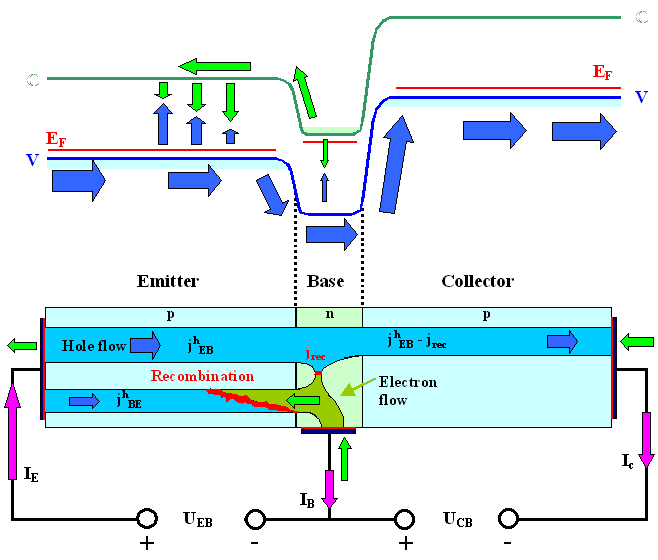
A band diagram and the flow of carriers is shown schematically below in a band diagram and
a current and carrier flow diagram. |
|
|
|
| |
|
Let's discuss the various currents going from left to right. |
| |
At the emitter contact, we have two hole currents, jEBh
and jBEh that are converted to electron currents that carry a negative charge away from
the emitter. The technical current (mauve arrows) flows in the opposite direction by convention. |
|
For the base current two major components are important: |
|
|
1. An electron current jBe, directly taken from the base
contact, most of which is injected into the emitter. The electrons are minority carriers there and recombine
within a distance L with holes, causing the small hole current component shown at the emitter contact.
|
|
|
2. An internal recombination current jrec caused by the few holes injected
into the base from the emitter that recombine in the base region with electrons, and which reduces jBe
somewhat. This gives us |
| |
|
|
|
Since all holes would recombine within L, we may approximate the fraction recombining in the base by
|
| |
|
|
Last, the current at the collector contact is the hole current jEBh – jrec which will
be converted into an electron current at the contact. |
|
The external terminal currents
IE,IB, and IC thus are related by the simple
equation |
| |
|
|
A bipolar transistor, as we know, is a current amplifier.
In black box terms this means that a small current at the the input causes a large current
at the output. |
|
|
The input current is IB, the output current IC.
This gives us a current amplification factor g of |
| |
|
|
|
Lets neglect the small recombination current in the base for a minute. The emitter current (density) then
is simply the total current through a pn-junction, i.e. in the terminology from the picture jE
= jBEh + jBe, while the base current is just the electron
component jBe. |
|
|
This gives us for IE/IB and finally for g: |
| |
IE
IB |
= |
jBEh + jBe
jBe | = k + 1 |
|
|
| |
| g | = |
IE
IB |
– 1 = k + 1 – 1
= k = |
NAc
NDon |
|
|
|
Now this is really easy! We will obtain a large current
amplification (easily 100 or more), if we use a lightly doped base and a heavily doped emitter. And since we can
use large base - collector voltages, we can get heavy power amplification, too. |
| |
Making better approximations is not difficult either. Allowing somewhat different properties of electrons
and holes and a finite recombination current in the base, we get |
|
|
| g = |
| · | æ
ç
è |
1 – | dbase
L |
ö
÷
ø |
» | NDon
NAc | · | æ
ç
è
| 1 – | dbase
L |
ö
÷
ø |
|
|
|
|
The approximation again is for identical life times and diffusion lengths. |
|
Obviously, you want to make the base width dbase
small, and keep L large. |
| | |
|
Real Bipolar Transistors |
| | |
|
Real bipolar transistors, especially the very small ones in integrated circuits, are complicated
affairs; for a quick glance on how they are made and
what the pnp or npn part looks like, use the link. |
|
Otherwise, everything mentioned in the context of real
diodes applies to bipolar transistors just as well. And there are, of course, some special topics, too. |
|
|
But we will not discuss this any further, except to point
out that the "small device" topic introduced for a simple p-n-junction now becomes a new quality: |
|
|
Besides the length of the emitter and collector part which are influencing currents in the way discussed,
we now have the width of the base region
dbase which introduces a new quality with respect to device dimensions and device performance. |
|
|
The numerical value of dbase (or better, the relation dbase/L),
does not just change the device properties somewhat, but is the crucial parameter that
brings the device into existence. A transistor with a base width of several 100 µm simply is not a transistor,
neither are two individual diodes soldered together. |
|
The immediate and unavoidable consequence is that at this point of making semiconductor devices,
we have to make things real small. |
| |
Microtechnology - typical lengths around or below 1 µm (at least in one dimension) - is mandatory.
There are no big transistors in more than two dimensions. |
|
|
Understanding microscopic properties of materials (demanding quantum
theory, statistical thermodynamics, and so on) becomes mandatory. Materials Science and Engineering
was born. |
| |
|
© H. Föll (Electronic Materials - Script)