|
The basic concept of a MOS
Transistor transistor is simple and best understood by looking at its structure: |
| |
|
|
 |
It is always an integrated structure, there are practically no single
individual MOS transistors. |
|
A MOS transistor is primarily a switch for digital devices. Ideally, it works as follows: |
|
|
If the voltage at the gate
electrode is "on" , the transistor is
"on", too, and current flow between the source
and drain electrodes is possible (almost) without losses. |
|
|
If the voltage at the gate electrode is "off
", the transistor is "off", too, and no current flows between the source and drain electrode.
|
|
In reality, this only works for a given polarity of the
gate voltage (in the picture above, e.g., only for negative gate voltages), and if the supply voltage (always called UDD)
is not too small (it used to be 5 V in ancient times around 1985; since
then it is declining and will soon hit an ultimate
limit around 1 V). |
|
|
Moreover, a MOS transistor needs very thin
gate dielectrics (around, or better below 10 nm), and extreme
control of materials and technologies if real MOS transistors are to behave as they are expected to in
"ideal" theory. |
|
What is the working principle of an "ideal" MOS transistor? |
|
|
In order to understand it, we look at the behavior of carriers in the Si under the influence of
an external electrical field under the gate region. |
| |
Understanding MOS transistor qualitatively
is easy. We look at the example from above and apply some source-drain voltage USD in either polarity,
but no gate voltage yet. What we have under these conditions is |
| |
A n-type Si substrate with a certain equilibrium density of electrons ne(UG
= 0), or ne (0) for short. Its value is entirely determined by doping (and the temperature,
which we will neglect at the present, however) and is the same everywhere. We also have a much smaller concentration nh(0)
of holes. |
|
|
Some p-doped regions with an equilibrium concentration of holes. The value of the hole concentration
in the source and drain defined in this way also is determined by the doping, but the value is of no particular importance
in this simple consideration. |
|
|
Two pn-junctions, one of which is polarized in forward direction (the one with the positive voltage
pole), and the other one in reverse. This is true for any polarity; in particular one junction will always
be biased in reverse. Therefore no source-drain current ISD
will flow (or only some small reverse current which we will neglect at present). |
| |
There will also be no current in the forwardly biased diode, because the n-Si of the substrate in
the figure is not electrically connected to anything (in reality, we might simply ground the positive USD
pole and the substrate). |
|
In summary, for a gate voltage UG = 0 V, there are no currents and everything
is in equilibrium. But now apply a negative voltage at the gate and see what happens. |
|
|
The electrons in the substrate below the gate will be electrostatically repelled and driven into the substrate.
Their concentration directly below the gate will go down, n e (U) will be a function of
the depth coordinate z . |
| |
| ne | = |
ne(z) = f(ne (0), U) |
|
|
|
|
Since we still have equilibrium, the mass action law for carriers holds anywhere in the Si, i.e. . |
| |
|
|
|
With ni = intrinsic carrier density in Si = const.(U,z) |
| |
This gives us |
| |
|
|
|
In other words: If the electron concentration below the gate goes down, the hole concentration goes up. |
|
If we sufficiently decrease the electron concentration under the gate by cranking up the gate
voltage, we will eventually achieve the condition nh (z = 0) = ne (z
= 0) right under the gate, i.e. at z = 0 |
|
|
If we increase the gate voltage even more, we will encounter the condition nh (z)
> ne (z) for small values of z, ie. for zc > z
> 0. |
|
In other words: Right under the gate we now have more holes than electrons;
this is called a state of inversion
for obvious reasons. Si having more holes than electrons is also called p-type Si.
What we have now is a p-conducting channel (with width zc)
connecting the p-conducting source and drain. |
|
|
There are no more pn-junctions preventing current flow under the gate - current can flow freely;
only limited by the ohmic resistance of contacts, source/drain and channel. |
|
Obviously, while cranking up the gate voltage with the right polarity,
sooner or later we will encounter inversion and form a conducting channel between our terminals which becomes more prominent
and thus better conducting with increasing gate voltage |
|
|
The resistivity of this channel will be determined by the amount of Si we have inverted; it will
rapidly come down with the voltage as soon as the threshold voltage necessary for
inversion is reached. |
|
If we reverse the voltage at the gate, we attract electrons and their concentration under the
gate increases. This is called a state of accumulation. The pn junctions at source
and drain stay intact, and no source - drain current will flow. |
|
|
Obviously, if we want to switch a MOS transistor "on" with a positive
gate voltage, we must now reverse the doping and use a p-doped substrates and n-doped source/drain regions. |
|
|
The two basic types we call "n-channel MOS" and "p-channel MOS" according to the kind of doping in the channel upon inversion (or
the source/drain contacts). |
|
|
Looking at the electrical characteristics, we expect curves like this: |
| |
|
|
|
The dependence of the source-drain current ISD on the gate voltage UG
is clear from what was described above, the dependence of ISD on the source-drain voltage USD
with UG as parameter is maybe not obvious immediately, but if you think about it a minute. you
just can't draw currents without some USD and curves as shown must be expected qualitatively. |
|
What can we say quantitatively about the working of an
MOS transistor? |
|
|
What determines the threshold voltage Uth, or the precise shape of the ISD(U
th) curves? Exactly how does the source - drain voltage USD influence the characteristics?
How do the prime quantities depend on material and technology parameters, e.g. the thickness of the gate dielectric and
its dielectric constant er or the doping level of substrate and source/drain? |
|
|
Plenty of questions that are, as a rule, not easily answered. We may, however, go a few steps beyond the
qualitative picture given above. |
| |
|
| Voltage at the gate |
Conditions in the Si |
Voltage drop |
Charge distribution |
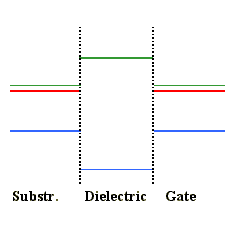
Zero gate voltage.
"Flat band" condition | |
| |
|
|
Nothing happens. The band in the substrate is perfectly flat (and so is the band in the contact
electrode, but that is of no interest). |
We only would have a voltage (or better potential) drop, if the Fermi energies of substrate
and gate electrode were different |
There are no net charges |
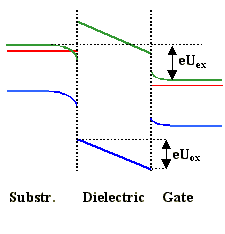
Positive gate voltage.
Accumulation | |
| |
|
|
With a positive voltage at the gate we attract the electrons in the substrate. The bands must
bend down somewhat, and we increase the number of electrons in the conduction band accordingly. (There is a bit of a space
charge region (SCR) in the contact, but that is of no interest). |
The voltage drops mostly in the oxide |
There is some positive charge at the gate electrode interface
(with our Si electrode from the SCR), and negative charge
from the many electrons in the (thin) accumulation layer on the other side of the gate dielectric. |
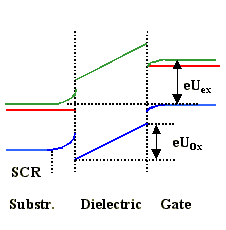
Small negative gate voltage.
Depletion | |
| |
|
|
With a (small) negative voltage at the gate, we repel the electrons in the substrate. Their
concentration decreases, the hole concentration is still low - we have a layer depleted of mobile carriers and therefore
a SCR. |
The voltage drops mostly in the oxide, but also to some extent in the SCR. |
There is some negative charge at the gate electrode interface
(accumulated electrons with our Si electrode), and positive charge smeared out
in the the (extended) SCR layer on the other side of the gate dielectric. |
Large negagive gate voltage.
Inversion
| | |
|
|
|
With a (large) negative voltage at the gate, we repel the electrons in the substrate very
much. The bands bend so much, that the Fermi energy (red line) is in the lower half of the band close to the interface.
In this region holes are the majority carriers, we gave inversion. We still have a SCR,
too. |
The voltage drops mostly in the oxide, but also to some extent in the SCR and the inversion
layer. |
There is more negative charge at the gate electrode interface
(accumulated electrons with our Si electrode), some positive charge smeared out
in the the (extended) SCR layer on the other side of the gate dielectric, and a lot of positive
charge from the holes in thin inversion layer. |
| |
|
|
|
|
Qualitatively, this is clear. What happens if we replace the (highly n-doped)
Si of the gate electrode with some metal (or p-doped Si)? |
|
|
Then we have different Fermi energies to
the left and right of the contact, leading to a built-in potential as in a pn-junction.
We will than have some band bending at zero external voltage, flat band conditions for a non-zero external voltage, and
concomitant adjustments in the charges on both sides. |
|
|
But while this complicates the situation, as do unavoidable fixed immobile charges in the
dielectric or in the Si-dielectric interface, nothing new is added. |
| |
Now, the decisive part is achieving inversion. It is clear that this needs some
minimum threshold voltage Uth, and from the pictures above, it is also clear that this request
translates into a request for some minimum charge on the capacitor formed by the gate
electrode, the dielectric and the Si substrate. |
|
|
What determines the amount of charge we have in this system? Well, since the whole assembly for any distribution
of the charge can always be treated as a simple capacitor CG, we have for the charge of this capacitor. |
| |
|
|
|
Since we want Uth to be small, we want a large gate capacitance
for a large charge QG, and now we must ask: What determines CG? |
|
If all charges would be concentrated right at the interfaces, the capacitance
per area unit would be given simply by the geometry of the resultant plate capacitor to |
| |
|
|
|
With dOx = thickness of the gate dielectric, (so far) always silicon dioxide SiO2. |
|
Since our charges are somewhat spread out in the substrate (we may neglect this in the gate
electrode if we use metals or very highly doped Si), we must take this into account. |
| |
In electrical terms, we simply have a second capacitor CSi describing the effects
of spread charges in the Si, switched in series to the geometric capacitor which we now call oxide
capacitance
COx
. It will be rather large for concentrated charges, i.e. for accumulation and inversion and small for depletion. |
|
|
The total capacitance CG then is given by |
| |
|
|
For inversion and accumulation, when the most of the charge is close to the interface, the
total capacitance will be dominated by COx. It is relatively large, because the thickness of the
capacitor is small. |
|
|
In the depletion range, CSi will be largest and the total capacitance reaches a minimum.
|
|
|
In total, CG as a function of the voltage, i.e. CG(U)
runs from a constant value at large positive voltages through a minimum back to about the same constant value at large positive
voltages. The resulting curve contains all relevant information about the system. Measuring CG(U)
is thus the first thing you do when working with MOS contacts. |
|
|
While it is not extremely easy to calculate the capacitance values and everything else that goes with it,
it can be done - just solve the Poisson equation for the problem. |
|
All things considered, we want COx to be large
, and that means we want the dielectric to be thin and to have a large
dielectric constant - as stated above without justification. |
| |
We also want the dielectric to have a large breakdown
field strength, no fixed charges in the volume, no interface charges, a very small tg d; it also should be very stable, compatible with Si
technology, and cheap. |
|
|
In other words, we wanted SiO2 - even so its dielectric constant is just a mediocre 3.9
- for all those years of microelectronic wonders. But now (2001), we want something better with respect to dielectric
constants. Much work is done, investigating, e.g., CeO2, Gd2O3, ZrO2,
Y2O 3, BaTiO3, BaO/SrO, and so on. And nobody knows today (2002
) which material will make the race! |
© H. Föll (Electronic Materials - Script)