| |
Voltage at the gate | |
Conditions in the Si |
Voltage drop |
Charge distribution |
| |
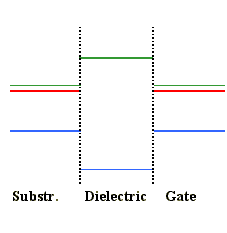
Zero gate voltage.
"Flat
band" condition | | |
| |
| |
| |
Nothing happens. The band in the substrate is perfectly flat (and so is the band in the contact
electrode, but that is of no interest). |
We only would have a voltage (or better potential) drop, if the Fermi energies of substrate
and gate electrode were different |
There are no net charges |
| |
Pos. gate voltage.
Accumulation | |
| |
|
|
|
| |
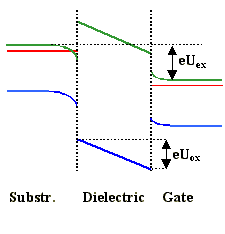
With a positive voltage at the gate we attract the electrons in the substrate. The bands must
bend down somewhat, and we increase the number of electrons in the conduction band accordingly. (There is a bit of a space
charge region (SCR) in the contact, but that is of no interest).
|
The voltage drops mostly in the oxide |
There is some pos. charge at the gate electrode interface
(with our Si electrode from the SCR), and negative charge from the many
electrons in the (thin) accumulation layer on the other side of the gate dielectric. |
| |
Small neg. gate voltage.
Depletion | |
| |
|
|
|
| |
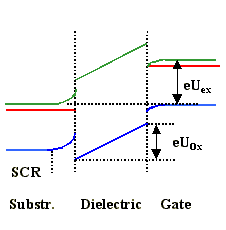
With a (small) negative voltage at the gate, we repel the electrons in the substrate. Their
concentration decreases, the hole concentration is still low - we have a layer depleted of mobile carriers and therefore
a SCR. |
The voltage drops mostly in the oxide, but also to some extent in the SCR. |
There is some negative charge at the gate electrode interface
(accumulated electrons with our Si electrode), and positive charge smeared out
in the the (extended) SCR layer on the other side of the gate dielectric. |
| |
Large neg. gate voltage.
Inversion | |
| |
|
|
|
| |
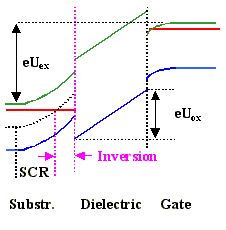
With a (large) negative voltage at the gate, we repel the electrons in the substrate very
much. The bands bend so much, that the Fermi energy (red line) is in the lower half of the band close to the interface.
In this region holes are the majority carriers, we have inversion. We still have a SCR,
too. |
The voltage drops mostly in the oxide, but also to some extent in the SCR and the inversion
layer. |
There is more negative charge at the gate electrode interface
(accumulated electrons with our Si electrode), some positive charge smeared out
in the the (extended) SCR layer on the other side of the gate dielectric, and a lot of positive
charge from the holes in thin inversion layer. |
 |
Qualitatively, this is clear. What happens if we replace the (highly n-doped)
Si of the gate electrode with some metal (or p-doped Si)? |
|
 |
Then we have different Fermi energies to
the left and right of the contact, leading to a built-in potential as in a pn-junction.
We will than have some band bending at zero external voltage, flat band conditions for a non-zero external voltage, and
concomitant adjustments in the charges on both sides. |
|
|
But while this complicates the situation, as do unavoidable fixed immobile charges in the
dielectric or in the Si-dielectric interface, nothing new is added. |
| |
Now, the decisive part is achieving inversion. It is clear that this needs some
minimum threshold voltage Uth, and from the pictures above, it is also clear that this request
translates into a request for some minimum charge on the capacitor formed by the gate
electrode, the dielectric and the Si substrate. |
|
|
What determines the amount of charge we have in this system? Well, since the whole assembly for any distribution
of the charge can always be treated as a simple capacitor CG, we have for the charge of this capacitor,
. |
| |
|
|
|
Since we want Uth to be small, we want a large gate capacitance
for a large charge QG, and now we must ask: What determines CG? |
|
If all charges would be concentrated right at the interfaces, the capacitance per
area unit would be given simply by the geometry of the resultant plate capacitor to |
| |
|
|
|
With dOx = thickness of the gate dielectric, (so far) always silicon dioxide SiO2. |
|
Since our charges are somewhat spread out in the substrate (we may neglect this in the gate
electrode if we use metals or very highly doped Si), we must take this into account. |
| |
In electrical terms, we simply have a second capacitor CSi describing the effects
of spread charges in the Si, switched in series to the geometric capacitor which we now call oxide
capacitance
COx.
It will be rather large for concentrated charges, i.e. for accumulation and inversion and small for depletion. |
|
|
The total capacitance CG then is given by |
| |
|
|
For inversion and accumulation, when the most of the charge is close to the interface, the
total capacitance will be dominated by COx. It is relatively large, because the thickness of the
capacitor is small. |
|
|
In the depletion range, CSi will be largest and the total capacitance reaches a minimum.
|
|
|
In total, CG as a function of the voltage, i.e. CG(U)
runs from a constant value at large positive voltages through a minimum back to about the same constant value at large positive
voltages. The resulting curve contains all relevant information about the system. Measuring CG(U)
is thus the first thing you do when working with MOS contacts. |
|
|
While it is not extremely easy to calculate the capacitance values and everything else that goes with it,
it can be done - just solve the Poisson equation for the problem. |
|
All things considered, we want COx to be large,
and that means we want the dielectric to be thin and to have a large
dielectric constant - as stated above without justification. |
| |
We also want the dielectric to have a large breakdown
field strength, no fixed charges in the volume, no interface charges, a very small tg d; it also should be very stable, compatible with Si technology,
and cheap. |
|
|
In other words, we wantedSiO2 - even so its dielectric constant is just a mediocre 3.9
- for all those years of microelectronic wonders. But now (2001), we want something better with respect to dielectric
constants. Much work is done, investigating, e.g., CeO2, Gd2O3, ZrO2,
Y2O3, BaTiO3, BaO/SrO, and so on. And nobody knows today (2002)
which material will make the race! |
| |
|
|
|
In 2007 we know more: It's HfO2; at least for Intel. For reasons of it's own,
Intel talks about Hafnium "metal", which makes no sense whatsoever |
|
| |
© H. Föll (MaWi 2 Skript)
 Mit Frame
 6.4.3 MOS Transistoren