 |
Here is the list of names around steel from the backbone: |
| |
- Cementite (German: Zementit). The stoichometric Fe3C
phase. It is a compound with a complicated lattice and rather hard and brittle.
- Ferrite (German: "Ferrit). The a-phase
with the bcc lattice. If you want to be precise, you call it a - ferrite.
- Austenite (German "Austenit). The g-phase
with the fcc lattice.
- Pearlite (German: Perlit), the two phase mixture obtained
right below the eutectoid point at 0.8 % C concentration
- Ledeburite (German: Ledeburit); the two phase mixture
obtained right below the eutectic point at 4.5 % C concentration.
- Martensite (German: Martensit); a kind of metastable
version of austenite + carbon; but with a tetragonal lattice and different mechanical
properties.
- Bainite (German: Bainit); a mixture of a
- ferrite supersaturated with carbon and cementite, but in a (non-equilibrium) structure
quite different from pearlite.
|
|
How did those names come into beeing? Let's see: |
|
The name Cementite - you might have guessed it - has something
to do with the english word "cement", meaning something that binds or glues
things together in this context. |
|
 |
In the words of a dictionary. "In 1885, Osmond and Werth published their "Cell-Theory",
in which not only the existence of allotropic forms of iron was proposed (now known as austenite and ferrite), but in which
also a new look at carbide formation was given. Their research on high-carbon steels, showed that the matrix consisted of
grains or cells of iron, encapsulated by a thin layer of iron carbide. During solidification, iron globules, or cells, are
formed first and continue to grow. The remaining melt solidifies as ironcarbide. In this way, the carbide-phase actually
glues or binds the previous formed cells together.
This view makes it understandable why Osmond called the iron-carbide thus formed, "Ciment"
(French for binder or cement)". |
|
|
Since English and German have words quite similar to the french ciment,
the precise name did not stick globally but is "cementite" in Englisch and
"Zementit" in German. |
|
Ferrite is practically self-explaining: |
|
|
Ferrum is the Latin root for many modern words around
iron and iron compounds. The word ferrum is possibly of Semitic origin. |
|
Austenite was named after Sir William Chandler Roberts-Austen, a British metallurgist (1843–1902). |
|
|
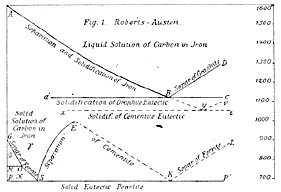
Roberts-Austen published the first iron-carbon phase diagram; in preliminary form 1897 (below),
and in a "final" form in 1899. |
| |
|
|
|
He is also remembered for being the first scientist who perfomed a quantitative measurement of diffusion
in the solid state (Au in Pb) after A. Fick established
his diffusion laws. |
|
Pearlite has its name frorm the pearl-like luster and iridescence
of its appearance. |
|
|
I could not yet find out, who coined this name and made it stick. |
| |
However, quite recent research can provide an explanation why this particular structure is
pearl-like in appearance: The regular spaced lamellae of optically quite different materials form a kind of "photonic crystal" with optical properties quite different
from those of the constituents. Real pearls get their luster from the same mechanism; the name "Pearlite" thus
is more fitting than its inventor could have known. |
|
Ledeburite is named after Adolf Ledebur (1837-1916). |
|
|
Ledebur was the first Professor for "Eisenhüttenkunde"
at the (famous) Bergakademie Freiberg. In 1882 he discovered the iron-carbon "Mischkristalle" and became
relatively famous. "Ledeburite" as a name for the iron - cementite eutectic was adopted in honor of his achievements.
|
|
Martensite was named after Adolf Martens (1850 - 1914). |
|
|
Martens started as an engineer, made it to the director of the royal mechanical laboratory,
which evolved into the "Staatliche Materialprüfungsamt" in Berlin. In Germany, a prestigious prize is now
awarded in his name. |
|
Bainite is named after the American chemist E. C. Bain. In the words of an US source: |
|
|
"The history of austempering begins in the 1930's, when Grossman and Bain, working
for the United States Steel Laboratories, were evaluating the metallurgical response of steels cooled rapidly from 1450°F
(788C) to intermittently high temperatures and held for various times. The outcome of their pioneering research is what
we now commonly call the "isothermal transformation diagram" Grossman and Bain were familiar with the conventional
metallurgical structures of ferrite, pearlite and martensite. What they discovered, however, was another structure, formed
above the martensite start temperature (Ms) and below the pearlite formation region. In steels, this structure took the
form of an acicular (plate-like) structure with a feathery appearance. X-ray diffraction later identified this structure
as a combination of ferrite and metal carbide. The resultant structure, termed "Bainite"
was found to be stronger and tougher than a comparable "quenched and tempered" structure. |
| | |
© H. Föll (MaWi 1 Skript)
 Mit Frame
 Geschichte des Stahls