|
You may be the foremost materials expert in
the world, but if you try to leave your mark on chip development without regard to some boundary conditions of a more economical nature, you will not achieve much. And if you are the manager
(which you should be with the kind of education you get here), you better be aware of the following points that are special
to research, development and manufacture of (memory) chips. |
|
 |
There is no other product with quite such brutal requirements, even considering
that all technical product development must follow similar (but usually much more relaxed)
rules. |
|
1. A new generation
with four-fold capacity will appear on the market every three years. |
|
|
That is an expression of "Moore's
law". It is, of course, not a "law" but an extrapolation from observation and
bound to break down in the not so distant future (with possible disastrous consequences to the economy of the developed countries).
|
|
|
The original observation made in 1965 by Gordon Moore,
co-founder of Intel, was that the number of transistors per square inch on integrated circuits
had doubled every year since the integrated circuit was invented. Moore predicted that this trend would continue for the
foreseeable future. In subsequent years, the pace slowed down a bit, but data density has doubled approximately every 18
months, and this is the current definition of Moore's Law, which Moore himself has blessed. Most experts, including Moore
himself, expect Moore's Law to hold for at least another two decades. |
|
|
Here is a graphic representation for microprocessors: |
| |
|
|
|
Not bad - but of course Moore's law must break down sometime (at the very latest when the
feature size is akin to the size of an atom (when would that be assuming that the feature size of the P7 is 0,2
µm?). This is illustrated in a separate module. |
|
|
Still, as long as it is true, it means that you either have your new chip generation ready
for production at a well-known time in the future, or you are going to loose large
amounts of money. There are some immediate and unavoidable consequences: |
|
|
You must spent large amounts of
money to develop the chip and to built the new factory 2 - 3 years before the chip is to appear on the
market, i.e. at a time were you do not know if chip development will be finished on time. And large
means several billion $. |
|
|
The time allowed for developing the new chip generation is a constant: You
can't start early, because everything you need (better lithography, new materials,) does not exist then. But since chip
complexity is ever increasing, you must do more work in the same time. The unavoidable conclusion is more people and shift work, even in research and development. |
|
|
It follows that you need ever increasing amounts of money for research and
development of a new chip generation (there is a kind of Moore's law for the costs of a new generation, too). Look at it in another way in a separate module. |
|
2. The market
for chips grows exponentially |
|
|
That is an expression of the insatiable demand for chips - as long as they provide more power
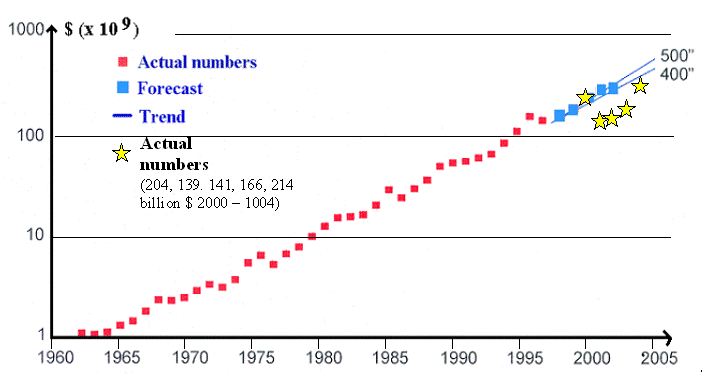
for less money! That this statement was true is shown below. Note that the scale is logarithmic!
|
| |
|
|
Shown is the total amount of money grossed in the semiconductor market from 1960
- 2000 (Source: Siemens / Infineon). |
|
|
The essentially straight line indicates exponential growth - including the foreseeable future.
Extrapolations, however, are still difficult. The two extrapolated (in 2000) blue lines indicating a difference of
100.000.000.000 $ of market volume in 2005 are rather close together. The error margins in the forecast thus
correspond to the existence or non-existence of about 10 large semiconductor companies (or roughly 150.000
jobs). |
|
|
We also see the worst downturn ever in 2001. Sales dropped from 204 billion
$ in 2000 to 139 billion $ in 2001, causing major problems throughout the industry. |
|
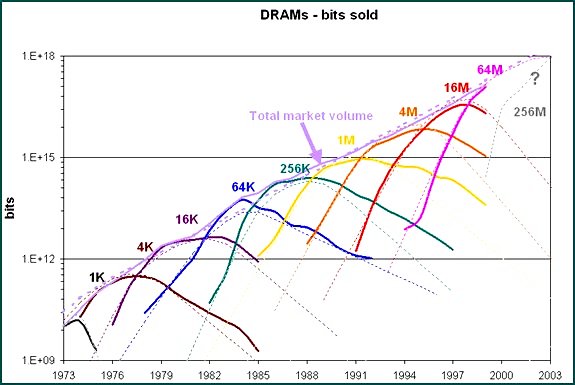
More specific, we can see the exponential growth of the market by looking at sales
of DRAMs. Shown is the total number of memory bits sold. Note that just a fourfold
increase every three years would keep the number of chips sold about constant because
of the fourfold increase of storage capacity in one chip about every three years. |
| |
|
|
|
The unavoidable consequence is: Your production capacity must grow exponentially,
too, if you just want to keep your share of the market. You must pour an exponentially growing
amount of money into investments for building factories and hiring people, while the returns on these investments
are delayed for at least 2 - 3 years. In other words: the difference of what you must spent and what you earn increases,
very roughly, exponentially. This is not a healthy prospect for very long, and you must make large
amounts of money every now and then (e.g. by being the first one on the market with a new chip or by having a
quasi monopoly). |
|
|
You must make (and sell at a profit) an exponentially
increasing number of chips (since the prize per chip is roughly constant) to recover your ever increasing costs.
Since chip sizes increase and prices must stay halfway constant, you must use larger wafers to obtain more chips per processing.
This puts a lot of pressure on developing larger Si crystals and equipment to handle them. |
|
|
You must produce as many chips as you can during the product life time (typically
5 years). Continuous shift work in the factory (7 days a week, 24 hours a day) are absolutely mandatory!
|
|
3. Chip prices
for memories decay exponentially from the time of their market introduction (roughly $60) by two orders of magnitude
within about 5 years (i.e. at the end you get $1). |
|
|
The prize development up to the 16 Mbit DRAM can be seen in
an illustration via the link. Microprocessors may behave very differently (as long as Intel has a quasi monopoly). The
rapid decay in prizes is an expression of fierce competition and mostly caused by: |
|
|
1. The "learning curve", i.e. the increase of the percentage of good
chips on a wafer (the yield) from roughly 15% at the beginning of the production to roughly
90% at the end of the product life time (because you keep working like crazy to improve the yield). |
|
|
2. Using a "shrink strategy" . This
means you use the results of the development efforts for the next two generations to make your present chip smaller. Smaller
chips mean more chips per wafer and therefore cheaper chips (the costs of making chips are mostly the costs of processing
wafers). |
|
|
An immediate consequence is that if you fall behind the
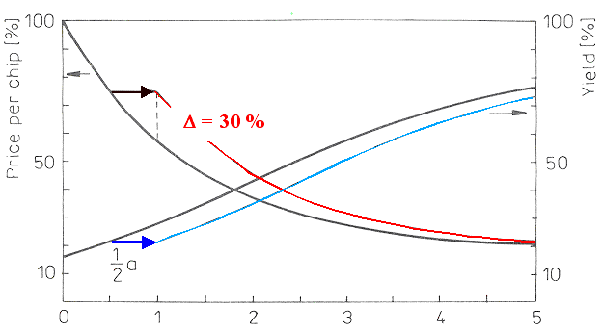
mainstream for 6 months or so - you are dead! This can be easily seen from a simple graph: |
| |
|
|
|
The descending black curve shows the expected trend in prizes (it is the average exponential
decay from the illustration). The ascending curve is the "learning
curve" needed just to stay even - the cost of producing one chip then comes down exactly as the expected prize. |
|
|
Now assume you fall behind 6 month - your learning curve, i.e. your yield of functioning
chips does not go up. You then move on the modified blue learning curve. The prize you would have to ask for your chip is
the modified red prize curve - it is 30 % above the expected world market prize in the beginning (where prizes are
still moderately high). |
|
|
Since nobody will pay more for your chips, you are now 30 % behind the competition
(much more than the usual profit margins) - you are going to loose large amounts of money! |
|
|
In other word: You must meet the learning
curve goals! But that is easier said then done. Look at real yield curves
to appreciate the point |
© H. Föll (Electronic Materials - Script)