 |
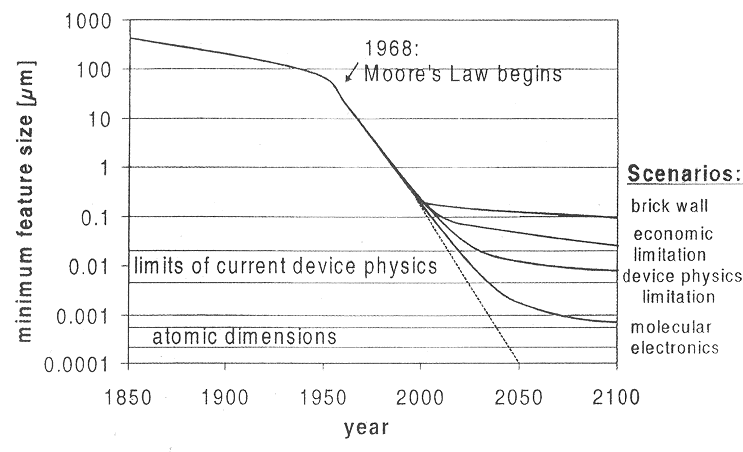
Here is an illustration of Moore's law with several scenarios for possible extrapolations. |
|
|
|
The dashed line shows the linear extrapolation. It is sure to break down - at the very last
when feature size come down to the level of atoms |
|
 |
The "molecular electronics" scenario thus must be seen as the best possible case
and would keep us going for another 20 - 30 years. |
|
|
On the other extreme, the "Brick wall" scenario assumes that technology simply hits an insurmountable
barrier right now. In other words, feature sizes will not come below about 0,1 µm ever. The end then would be
near. |
|
|
In between are scenarios where feature size reduction is either limited by the costs (in other word, you
can make it, but it is to expensive to sell) and device physic limitations. After all, a conventional MOS transistor
needs at least a few doping atoms in its source and drain region and since the density of doping atoms must be considerably
smaller than the density of Si atoms, you cannot make the transistor components arbitrarily small. |
|
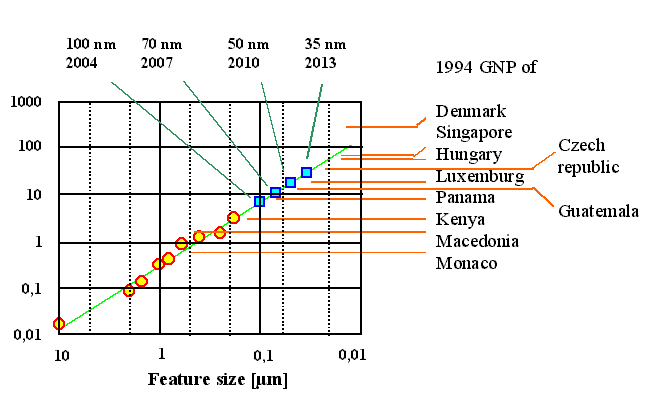
What "economic limitations" mean is illustrated in the next picture |
| |
|
|
|
Here the costs of chip development is plotted (circles) and from the extrapolation of the resulting rather
straight line predicted for the coming years (squares) and compared to the gross national product (GNP) of sizeable countries |
|
|
The problem will be to recover these costs at roughly the same prize per chip. It means that you have to
sell at lot more chips at each generation. Assuming that the capacity in memory chips increases fourfold every three years,
the market for bits then has to grow much faster than about 60% a year! |
|
| |
© H. Föll (Electronic Materials - Script)
 5.4.1 Development and Production of a New Chip Generation
  With frame