|
The key element of electric engineering, computer engineering, or pretty much
everything else that is remotely "technical" in the last thirty years of the 2nd millennium, is the integrated transistor in a Silicon
crystal - everything else comes in second - at best. |
|
 |
Integrated means that there is more than one transistor
on the same piece of Si crystal and thus in the same package. And "more than one"
means at the present stage of technology some 107 transistors per cm2
of Silicon. |
|
|
Silicon crystal means that we use huge, extremely perfect
single crystals of Si to do the job. Why Si and not. for exampleGe, GaAs or SiC? Because
if you look at the sum total of the most important properties you are asking for (crystal size and perfection, bandgap, extremely good and process compatible dielectric, ...) Si and its oxide, SiO2
are so vastly superior to any possible contender that there is simply no other semiconductor that could be used for complex
integrated circuitry. |
|
The lowly integrated circuit (IC), mostly selling for a few
Dollars, is the most marvelous achievement of Materials Science in the second half of the 20th century. Few people
have an idea of the tremendous amount of science and engineering that was (and still is) needed to produce a state-of-the
art chip, the little piece of Si crystal with some other materials in precise arrangements,
that already starts to rival the complexity of the brains of lower animals and might at some day in the not so distant future
even rival ours. |
|
If we want to make a circuit out of many transistors (some
of which we use as resistors) and maybe some capacitors, we need three basic ingredients
- no matter if we do this in an integrated fashion or by soldering the components together - and on occasion some "spices",
some special additions: |
|
1. Ingredient:
Transistors. "Big" and "small" ones (with respect to the current
they can switch), for low or high voltage, fast or not so fast - the whole lot. We have two basic types to chose from: |
|
|
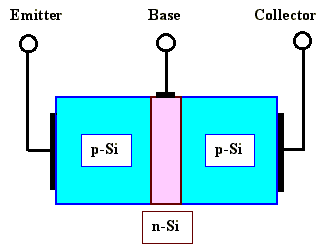
Bipolar transistors (the hopefully familiar pnp- or npn-structures)
are usually drawn as follows |
|
|
|
|
|
Note right here that no real transistor looks even remotely like this structure! It's
only and purely a schematic drawing to show essentials and and has nothing whatsoever to do with a real transistor. |
|
|
The name bipolar
comes from the fact that two kinds of carriers, the negatively charged electrons
and the positively charged holes, are necessary for its function. |
|
|
MOS
Transistors or unipolar Transistors, more
or less only exist in integrated form and usually are drawn as follows: |
|
|
|
|
2. Ingredient:
Insulation. Always needed between transistors and the other electrically active parts of the circuit.
|
|
|
In contrast to circuits soldered together where you simply use air for insulation, it does not come "for
free" in ICs but has to be made in an increasingly complex way. |
|
3. Ingredient:
Interconnections between the various transistors or other electronic elements - the
wires in the discrete circuit. |
|
|
The way you connect the transistors will determine the function of the device. With a large bunch of transistors
you can make everything - a microprocessor, a memory, anything - only the interconnections must change! |
|
Then we may have special elements |
| |
These might be capacitors, resistors or diodes on your chip. Technically, those elements are more or less
subgroups of transistors (i.e. if you can make a transistor, you can also make these (simpler) elements), so we will not
consider them by themselves. |
|
If you did the required reading, you should be familiar with the basic physics of the two transistor
types; otherwise do it now!!! |
|
| |
|
The list of necessary ingredients given above automatically implies that we have to use several
different materials. At the very minimum we need a semiconductor (which is practically
always Silicon; only GaAs has a tiny share of the IC market, too), an insulator
and a conductor. As we will see, we need many more materials than just those three basic
types, because one kind of material cannot meet all the requirements emerging from advanced Si technology. |
|
|
Since this lecture course is about electronic materials
, it may appear that all we need now is a kind of list of suitable materials for making integrated circuits. But that
would be far too short sighted. In IC technology, materials and processes must
be seen as a unit - one cannot exist without the other. |
|
|
We therefore have to look at both, materials with their specific properties and their integration into
a process flow. |
|
Todays integrated circuits contain mostly MOS transistors, but we will start with considering
the integration of bipolar transistors first. That is not only because historically bipolar transistors were the first ones
to be integrated, but because the basic concepts are easier to understand. |
|
|
| |
|
| |
© H. Föll (Electronic Materials - Script)