One-dimensional lattice vibrations
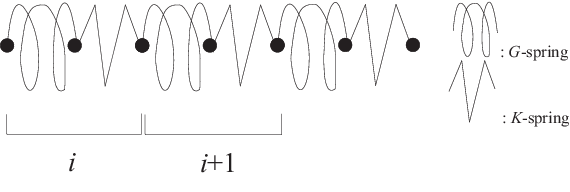
We investigate a chain of identical atoms which are coupled by different kinds of springs:
Always two atoms form a unit (basis) addressed by an index
.
The lattice distance shall be .
The excursion of both atoms is denominated by
and
:
for the potential energy we find:
|
| (3.19) |
The equations of motion are:
|
| (3.20) |
|
| (3.21) |
|
| (3.22) |
|
| (3.23) |
Including this into Eq. (3.20) and Eq. (3.21) we get:
|
| (3.24) |
|
| (3.25) |
We find
|
| (3.26) |
and
|
| (3.27) |
For the different
-values we always find
two -values, i.e. we find
modes; this corresponds
to the degrees of
freedom (2 atoms in
elementary cells).
We can choose
|
| (3.28) |
The both solutions are:
1)
|
| (3.29) |
i.e. both atoms oscillate in anti-phase. If the atoms are charged, thus a dipole moment would be
introduced. Light can couple at this oscillations. Therefor the solution is called the optical
mode.
2) We find
|
| (3.30) |
i.e. both atoms oscillate in phase. We will find density oscillations within the crystal. A sound wave will move through the crystal. Therefor his solution is called the acoustic mode.