 |
For the basic solution and the dispersion relation (energy vs. momentum / wave vector), due
to the boundary conditions we now obtain |
| |
| y (x, y, z) |
= |
Ak · |
sin(kx · x) · sin(ky · y) · sin(kz
· z) |
| E = |
 2 · k2 2 · k2
2 m |
|
|
|
 |
Obviously, the boundary conditions y (x = 0) = y (x = L) = 0 (and analogously so for y and z) are satisfied by
|
| |
| kx | = |
nx · p
L | | | |
| | nx |
= | 1, 2, 3, ... |
|
|
|
|
and analogously so for the y and z direction. The amplitude factor
Ak follows from the condition that the probability to have the electron in the "box"
equals 1: |
| |
| 1 = |A k|2 |
L
∫
0 |
sin2 (kx · x) d x |
L
∫
0 |
sin2 (ky · y) dy |
L
∫
0 |
sin2 (kz · z) dz |
|
|
|
|
Hence, here we have |Ak
|2 = (2/L) 3 , independent of k. |
|
The number of states Z(k) up to a wave vector k
is generally given by |
| |
| Z (k) | = |
Volume of sphere with radius E(k)
Volume of state |
|
|
|
For fixed boundary conditions we have |
|
|
| Z(k) | = |
1
8 | · |
4/3 (p · k)3
(p/ L)3 |
= | (k · L)3
6p2 |
|
|
|
This is exactly what we would get for the periodic boundary conditions –
thanks to the factor 1/8. |
|
|
Where does this factor come from? Easy – since the quantum numbers n are restricted
to positive integers in this case, we can not count states in 7 of the 8 octants of the complete sphere and
must divide the volume of the complete sphere by 8. |
|
|
This becomes clear if we look at a drawing of the possible states in phase space: |
| |
|
© H. Föll (Semiconductors - Script)
 Exercise 2.1-1 Free Electron Gas with Constant Boundary Conditions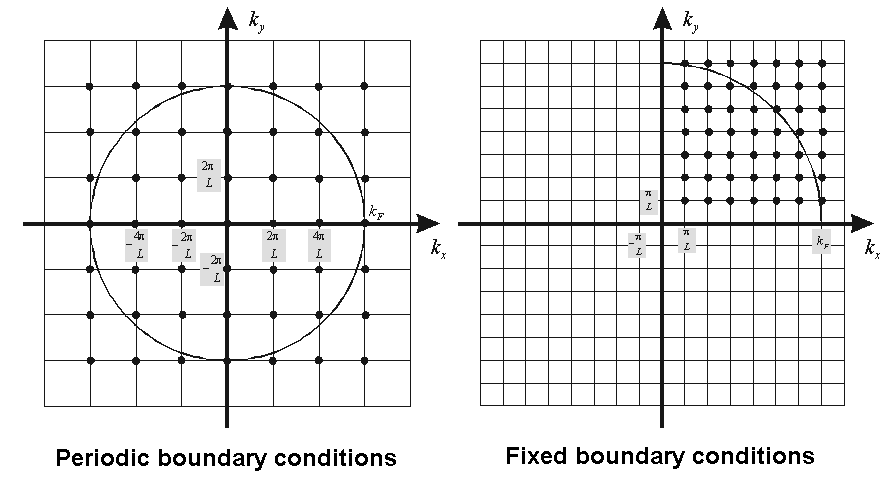
 With frame