 |
We first give a very short proof for a special case which is taken from the book of Kittel
("Quantum Theory of Solids"). It treats the one-dimensional case and is only valid if y
is not degenerate, i.e. there exists no other wavefunction with the same k and energy E. |
| |
|
 |
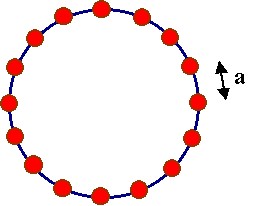
We consider a one-dimensional ring of lattice points with the geometry as shown in the picture. |
|
|
|
|
This is of course just a representation of a one-dimensional crystal consisting of N atoms
with spacing a and periodic boundary conditions. |
|
|
|
The potential V thus is periodic in x with period length a, i.e.
we have V(x) = V(x + s · a) with s = integer. |
|
| |
| |
|
The decisive thought invokes symmetry arguments. Since
no particular coordinate x along the ring is different in any way from the coordinate (x + a),
we expect that the value of any wave function y(x) will differ at most by some
factor C from the value at (x + a), i.e. |
|
| |
|
|
|
| | |
| |
If we now proceed from (x + a) to (x + 2a) , or to x
+ Na, we obtain |
| |
|
| |
| y(x + 2a) | = | C
2 · y (x) | | |
| | | | | |
| y(x + Na) | = |
CN · y (x) | = |
y(x) |
|
|
| | |
| |
because after N steps we are back at the beginning. |
| |
We thus have CN = 1 and C must be one of the
N roots of 1, i.e. |
| |
|
| |
|
| |
|
| |
With s = 0, 1, 2, 3, ..., N – 1 |
|
We now have y(x + a) = y(x)
· exp(i2ps/N) and this equation is satisfied if |
| | |
| |
| y (x) | = |
uk(x) · exp |
i · 2p · s · x
N · a
|
|
|
| | |
| |
With uk(x) = uk(x + a), i.e. for any function u
that has the periodicity of the lattice. |
|
|
Try it: |
| |
|
| |
| | y(x + a) |
= | uk(x + a) · exp |
i · 2p · s · (x + a)
N · a |
| | y(x + a) |
= | uk(x) · exp |
i · 2p · s · x
N · a | · exp |
i · 2p · s
N |
= |
y (x) · exp |
i 2p · s
N |
|
|
| | |
| |
If we introduce k = 2ps /Na
we have Bloch's theorem for the one-dimensional case.
q.e.d. |
| |
|
|
This "proof", however, is not quite satisfactory. It is not perfectly clear if solutions
could exist that do not obey Bloch's theorem, and the meaning of the index k is left open. In fact, we could have
dropped the index without losing anything at this stage. |
|
|
It does, however, give an idea about the power of the symmetry considerations. |
|
A very similar proof is contained in the relevant Alonso–Finn book ("Quantum and
Statistical Physics"). It uses a slightly different approach in arguing about symmetries. |
| |
Again, we consider the one-dimensional case, i.e. V(x) = V(x + a) with
a = lattice constant. |
|
|
But now we argue that the probability of finding an electron at x,
i.e. |y(x)|2
, must be the same at any indistinguishable position, i.e. |
|
|
|
|
|
This implies |
| |
| y(x + a) | = |
C · y(x) |
| | | |
| |C|2 | = |
1 |
|
|
|
|
We thus can express C as |
| |
|
|
|
for all a and k. At this point k is an arbitrary parameter (with
dimension 1/m). This ensures that |C|2 = exp (ika) · exp (–ika) = 1 |
|
|
We thus have |
| |
| y(x + a) | = |
exp(ika) · y(x) |
|
|
|
|
And this is already a very general form of Blochs theorem as shown below. |
| |
Writing it straight forward for the three-dimensional case we obtain the general version of
Bloch's theorem: |
| |
| yk(r + T) |
= | exp (ik
· T) · yk(r) |
|
|
|
|
with T = translation vector of the lattice and r =
arbitrary vector in space. |
|
|
The index k now symbolizes that we are discussing that particular solution of the Schrödinger
equation that goes with the wave vector k. |
|
The generalization to three dimensions is not really justified, but a rigorous mathematical
treatment yields the same result. The more common form of the Bloch theorem with the modulation function u(k)
can be obtained from the (one-dimensional) form of the Bloch theorem given above as follows: |
| |
Multiplying y (x) = exp(–ika) · y
(x + a) with exp(–ikx) yields |
|
|
| exp (–ikx) · y (x) |
= |
exp (–ikx) · exp(–ika) · y(x + a) |
= |
exp (–ik · [x + a]) · y(x + a) |
|
|
|
This shows unambiguously that exp(–ikx) · y(x)
= u(x) is periodic with the periodicity of the lattice. |
| |
And this, again, gives Bloch's theorem: |
| |
|
|
Once more, no index k at y or u is required.
We also did not require specific boundary conditions. The meaning of k, however, is left unspecified. Of course,
the plane wave part of the expression makes it clear that k
has the role of a wave vector, but it has not been explicitly introduced as such. |
| |
© H. Föll (Semiconductors - Script)
 With frame
 2.1.4 Periodic Potentials