|
If an equilibrium is disturbed, it takes a certain time before it is restored
again; this is described by the kinetics
of the processes taking place. In a strict sense of speaking, the Fermi energy is not defined without equilibrium,
but only after it has been restored. This restoring process occurs in the bands and between the bands: |
|
 |
In the bands, local
equilibrium (in k-space) between the carriers will be obtained after there was time for some collisions, i.e.
after some multiples of the scattering time. This
process is known as thermalization
and occurs typically in picoseconds. |
|
|
Between the bands, equilibrium will be restored by generation
and recombination events and this takes a few multiples of the carrier life time,
i.e. at least nanoseconds if not milliseconds. |
| |
This means that we can have a partial (or local) equilibrium
in the bands long before we have equilibrium between the bands. This local equilibrium
implies that: |
|
|
Non-equilibrium means something changes in time. Changes in the properties of the particle
ensemble considered (i.e. electrons and holes) in local
equilibrium are only due to "traffic" between the bands while the properties
of the particles in the band do not change anymore. The term "local" of course, does not refer to a coordinate,
but to a band. |
|
|
The carrier densities therefore do not have their total or global equilibrium
value as given, e.g., by the mass action law, but their local equilibrium density
can still be given in terms of the equilibrium distribution by |
|
|
|
ne = Neffe · exp – |
EC – EF
e
kT |
|
nh = Neffh · exp – |
EFh – EV
kT |
|
|
|
|
with the only difference that the Fermi energy now is different
for the electrons and holes. Instead of one Fermi energy EF
for the whole system, we now have two
Quasi Fermi energies, EFe
and EFh. |
|
For the product of the carrier densities we now obtain a somewhat
modified mass-action law |
| |
|
ne · nh = Neffe · Neffh
· exp – |
(EC – EV) + (EFh
–
EFe)
kT |
= |
ni2 · exp – |
EFh – EF
e
kT |
|
|
|
|
For this we used the by now basic relation |
| |
|
Neffe · Neffh · exp – |
EC – EV
kT
| = ni2 |
|
|
| |
The name "Quasi Fermi energy" is
maybe not so good, there is nothing "quasi
" about it. Still, that's the name we and everybody else will use. Sometimes it is also called "Imref"
(Fermi backwards), but that doesn't help much either. |
|
|
Rewriting the equations from above gives a kind of definition for the Quasi Fermi energies: |
| |
| EF
e = EC – kT · ln |
Neffe
ne |
|
EFh = EV + kT · ln |
N effh
nh |
|
|
|
Quasi Fermi energies are extremely helpful for the common situation where we do
have non-equilibrium, but only between the bands – and that covers most of semiconductor
devices under conditions of current flow (due to an applied voltage) or under illumination. We will make frequent use of
Quasi Fermi energies! |
|
|
|
Carrier Densities and Quasi Fermi Energies |
| | |
|
If we calculate carrier densities in non-equilibrium with the
Quasi Fermi energies, we have to be careful to use the right Quasi Fermi energy in the Fermi-Dirac formula or in the Boltzmann
approximation. |
|
|
After all, we now have two (Quasi) Fermi
energies, one "regulating" the density of electrons in the conduction band, and the other one doing the same for
the holes in the valence band. That was already implied above, here we want to make this
topic a bit clearer; we also introduce a new distribution function as a kind of short-hand. |
|
|
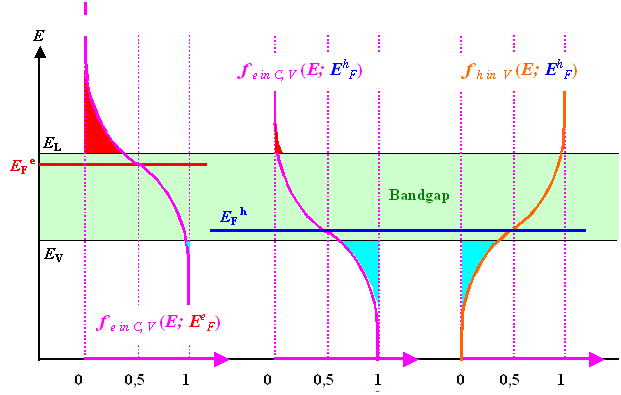
You really must now write f(E, EFe , T)
or f(E, EFh, T) instead of simply f(E, EF,
T) or f(E) because, due the different arguments, the meaning of these two expressions is now different.
This is illustrated below with the two curves on the left and should be obvious. |
|
|
In the pictures we even have some redundancy by writing fe in C(E, EFe,
T) and so on. This is not necessary, but helps in the beginning to avoid mix-up. |
| |
|
|
The density of electrons or holes in the conduction or valence band, respectively,
would now be |
| |
|
ne = Neffe · [fe in C(E, EF
e, T)] |
» |
Neffe · exp – |
EC – EF
e
kT |
| | |
| |
|
nh = Neffh · [1 – fe in V(E, EFh,
T)] | » |
Neffh · exp – |
EFh – EV
kT |
|
|
|
|
The red or blue triangles above symbolize the density of electrons in the conduction band
or holes in the valence band, respectively, as before. |
|
The right-hand side is identical (of course) to what we had above
and shows a kind of symmetry not contained in the formulation with the Fermi distribution, where we have f(E,
EF h, T) and 1 – f(E, EFh, T). |
|
|
This can be remedied easily by simply setting 1 – f(E, E
Fh, T) =: fh in V(E,
EFh, T) with f h in V being the probability
of finding holes on the available states in the valence band. |
|
|
This is the curve shown on the right-hand side in the picture above. |
|
If we use that definition, we obtain more symmetry at the cost of more heavily
indexed functions. It's a matter of taste. |
|
|
However, later we will encounter situations where proper bookkeeping of electrons and holes
is complicated and essential. Then it might be easier to keep the situation symmetric, to use fh in V
for the holes in the valence band, and to express all carrier densities in the valence
band with fh in V, while in the conduction band we use fe in C. |
|
|
|
© H. Föll (Semiconductors - Script)