 |
While our basic experiment of putting some surface charge on a semiconductor surface that
is insulated by a (fictive) very thin featureless insulator is simple,
the necessary solutions of the Poisson equation were not. |
|
 |
Special cases, centered around some basic assumptions and concommitant mathematical approximations,
had to be constructed and were treated separately: |
|
| and most of them proved to be rather tedious. |
|
|
Fortunately, given the tremendous importance of these cases for semiconductor technology, other people
have looked at this problem in great detail, and here we are just looking at some major results for the general case. |
|
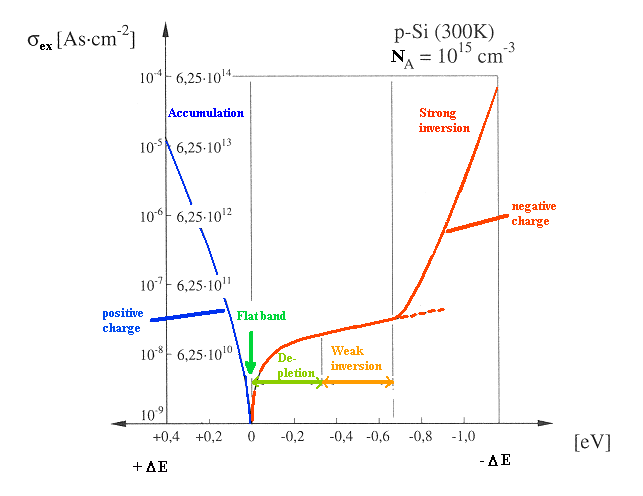
Here we put everything together again. The essential picture shows the maximum
amount of band bending (i.e. at x = 0 where we have our external surface charge) as a function of the surface
charge (always proprotional to the external voltage). |
|
|
The curve obtained from a proper solution of the complete
Poisson equation must contain as parameters the doping concentration and the temperature - the Debye length
in other words. |
|
|
Here is one version, calculated for p-type Si with an acceptor concentration
of 1015 cm–3 (i.e. a typical doping concentration corresponding
to a resistivity of about 1 Wcm. |
| |
|
© H. Föll (Semiconductors - Script)
 With frame
 2.3.4 Useful Relations