 |
Here we look at products
containing semiconductor technology, i.e. small but essential part of eletrical engineering. Analyzing this products leaves
us with components
and finally with materials and processes for semiconductor technology - we run into materials science
at its finest. |
|
 |
Products we define simply as something you
and I do buy or at least could buy. We also include
services in this category. |
|
|
Components are whatever one finds inside a product; e.g. "Chips", light emitting diodes (LED's), or liquid crystal displays (LCD's) |
|
|
At least some components of our products of interest are made from semiconductors
. What we want to learn in this course then is simply - Which Semiconductors do we use?
- How do we make the component we want?
|
|
These questions go deeper then it may appear on first sight. Let's look at two examples: |
|
So we use Si for our component "chip". But just saying Silicon is not good enough.
|
| |
Do we use single-crystalline Si, poly-crystalline Si or amorphous Si? Or perhaps nano-crystalline
Si with some amorphous regions? |
|
|
If we use single crystalline Si, do we go for Czochralski-grown (CZ) single-crystals or for float zone
(FZ) single-crystals, or possibly just for an epitaxial
layer? |
|
|
OK - we take the CZ wafer. What doping type would you like? p - or n-type? All right, we take the
n-type, well done - thank you very much. |
|
|
Sorry, we're not done yet. Would you prefer P-doping or As-doping? Or may we recommend today's special:
Sb-doping? And what kind of interstitial oxygen concentration may I offer to you? We have a large selection for every taste.
|
| |
You get the drift. And as in any good restaurant, you will "taste" the difference. What you get as a component
depends on your detailed specification. |
|
Now let's make a solar cell. From Si or from something else? |
| |
In fact, we make (and you and I can buy it) solar cells from all kinds of Si mentioned above, but also from GaAs,
from CuInSe2, from CdTe, from TiO2 and from a growing number of other semiconductors
and combinations of different semiconductors. |
| | |
|
Why, oh why are we doing this? It seems to make life so complicated. Can't we decide on the
best material and process for solar cells and be done with it? |
|
|
Well, being the boss of a large solar cell company, you actually must make this decision - you can not
possible run a multitude of factories, each with its own materials and processes; you must make a choice for one, or maybe
just two basic product lines. |
|
|
The same is true for your competitor. If his choice is different from yours, the market will tel in good
time, which one of you guys made the better choice. |
|
In other words: if we look at products, we do not just look at technical topics, we actually
look at economical issues! Money, not Nobel prizes is the decisive
factor in the end! |
|
|
|
Products, Components and Materials |
| | |
|
As a human being, you encounter all kinds of products and services all the time
- and you rarely think about what is hidden behind the obvious. You pick up your (cell)phone, dial a number or press a button,
and expect that within seconds you will be able to talk to the person of your choice - whoever and wherever that person
might be. |
|
|
If a regular human being gives the "behind the obvious" any thoughts,
he or she will probably conclude, in the words of Dave Barry,
"that cell phones are operated by magic ". |
|
|
As a (budding) Materials Scientist and Engineer, you know better. Behind the obvious is semiconductor
technology. Not exclusively, and not always, but "immer öfter" (ever more often). |
| |
Note that not all that long ago (for elderly professors) - in the 1950
ties - the number of semiconductor products was exactly zero. |
|
|
Now we have such a large diversity of products, components and semiconductors all around us that we can
hardly do more than scratch the surface in this course. |
|
| |
|
Markets and Growth |
| | |
|
The very first semiconductor products intentionally made (i.e. based on understanding
what is going on) hit the market in the late fifties / early sixties of the 20th century - in the form of "transistors",
a word not used for a transistor per se, but for a transistor radio. |
|
|
This was an unbelievable big product achievement,
because, for the first time in human history it enabled everybody to make a lot of noise in public - without any skills
and exertion. Of course, the transistor radio was an instant success. |
|
|
A portable, battery-run "transistor" contained about 20 (Ge) transistors,
already some progress in comparison to your big and heavy home radio, that may have contained about 10 vacuum tubes
as active elements. |
|
Putting several transistors on one piece of Si, i.e. making an integrated circuit (IC), was the next big (double) step in technological development; it consisted of switching
to Si as base material and in finding ways for integration. |
|
|
Since then semiconductor technology is an unprecedented success story - it is now (2007)
arguably the world-wide biggest industry with respect to product penetration. |
|
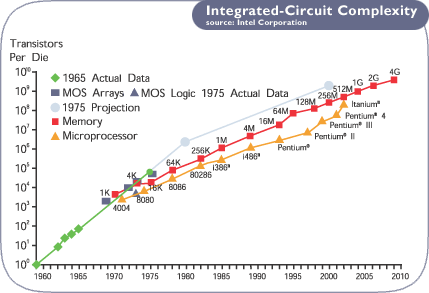
The key word in this respect is "Moore's law",
simply stating that any quantitative measure of progress in IC technology grows exponentially "forever"
with growth rates in the 30 % range. |
|
|
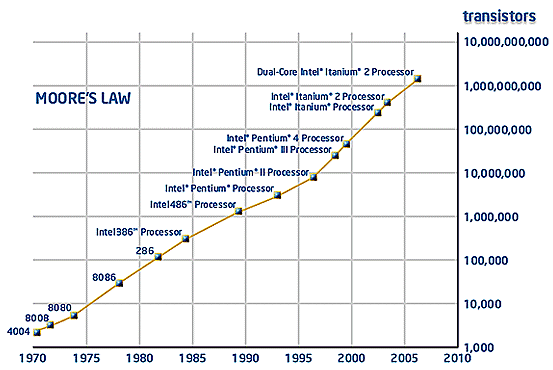
Typical measures are, for example, the number of transistors on one chip, almost the same
as the number of bits one can store in one memory chip. What that looks like is shown in the figure below - note the logarithmic
scale |
| |
Memories and micro processors |
 |
Intel processors
Courtesy of Intel Corp. |
|
|
The implications of exponential growth for by now more than 40 years are
staggering - use the link if you want to have just
a flavor of this. We will just look at two points in this context: |
|
|
The world has changed in a major way in the last 20 years or so because of semiconductor
technology. Think about this yourself. Hint: Consider what hides behind catch words
like "Internet", "electronic warfare", "Resonance tomography", "globalization",
"energy crisis", ...., in technical, social and political terms. |
|
|
Exponential growth never
continues forever.In fact, since about 1985 serious people believed (or actually tried to prove) that
it will be over soon. When it will be over, meaning that growth rates come down to "normal" values of a few perscent,
all kinds of problems might occur - witness the bursting of the (stock market) "Internet bubble" in 2000
or the bursting of the USA real estate bubble right now (Aug. 2007) - all caused by the sudden end of exponential
growth. If we are lucky, we will have a "soft landing" in the IC business; if we are even luckier, the
foreseeable slack in the IC business will be compensated for by growth in other areas of semiconductor technology,
e.g. solar cells. |
|
Where does this leave you? If the 30%
per year growth rate peters off, will there be jobs? Is it sensible to learn about semiconductor technology now when it
soon will be "over"? |
|
|
For an answer, look at the German car industry. Seen with semiconductor industry eyes, technical
progress in making cars in the last 40 years or so was close to zero - compared to semiconductor products. A factor
of two in total performance progress (top speed, gas consumption, ..) in these 40 years is already seen as enormous
progress. Compare with memory chips: 1978: 16 kbit, 2007: 16 Gbit; improvement factor 106
. |
|
|
Yes - but: The car industry is still the largest industrial branch in Germany with lots of
jobs.... |
© H. Föll (MaWi für ET&IT - Script)


