| |
 |
The Poisson
equation in its simplest form reads |
| |
|
|
 |
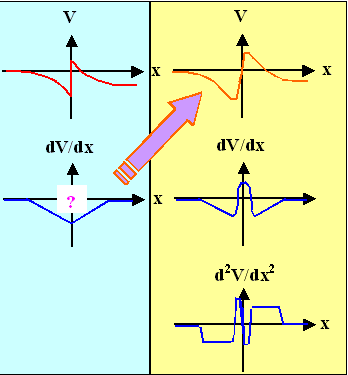
Differentiating the potential V including possible discontinuities thus will
gives us the charge distribution r( x). We can do that very easily in a qualitative
way as shown on the left hand side below. |
|
|
|
|
|
Note that an infinitely sharp discontinuity will not be
noticed in the dV/dx curves. The curves we get are identical to the old
curves that did not contain a discontinuity. |
|
But infinitely sharp discontinuities, or singularities
in general, mostly do not make sense in physics. All we have to do therefore, is to redraw the potential with the discontinuity
spread over a small distance (obviously in the order of the atom size at the very minimum) |
| |
Differentiating graphically in a qualitative way now is easy, this is shown on the right hand
side. |
|
|
We now get a sharp "wiggle" in the charge distribution, corresponding to a dipole layer of charge right at the interface. |
© H. Föll (Semiconductors - Script)
 Solving the Poisson Equation for p-n-Junctions
  With frame