| |
 |
Calculating the critical thickness of a layer with lattice constant a1
on top of a substrate with lattice constant a2 can become rather involved, if all components contributing
to the elastic energy are taken into account. |
|
 |
In particular, you may want to consider the anisotropy of the situation, the effect of a finite
thickness of the top layer, the real geometry with respect to the dislocations (their line energy depends on this and that,
and they may be split into partial dislocations). |
|
|
Then, after arriving at a formula, you may chose to make all kinds of approximations. |
| |
In the backbone part of the script we had a simple formula (taken from a paper of the very well known scientist
Sir Peter Hirsch) which you can find in the link
(together with some comments): |
| |
| dcrit = | = |
b
8 · p · f · (1 +
n) | · ln |
e · dcrit
r0 |
|
|
|
|
With b = Burgers vector of the dislocations; usually
somewhat smaller than a lattice constant, f = misfit parameter = (a1 - a2)/a1,
n = Poisson ration » 0,4, e = really e
= base of natural logarithms r0 = inner core radius of the dislocation; again in the order of lattice
constant. |
|
Lets look at some other approaches |
|
|
A formula taking into account most everything going back to J. W.
Matthews and A.E. Blakeslee (1974) , who
pioneered this field of research, is |
| |
| dcrit | = |
b · (1 – n ) · cos2Q
8 · p · (1 + n)
· f · cosl | · |
æ
ç
è |
ln | æ
è |
dcrit
b |
ö
ø | + 1 |
ö
÷
ø |
|
|
|
|
with Q = angle between the dislocation line and its Burgers vector, l = angle between the slip direction and that line in the interface plane that is normal to the
line of intersection between the slip plane and the interface. |
|
|
For simple systems (Q = 90o and l
= 0o), we have |
| |
| dcrit | = |
b
8 · p · f · (1 +
n) | · |
æ
ç
è | ln |
æ
è |
dcrit
r0 |
ö
ø | + 1 |
ö
÷
ø |
|
|
|
|
And that is Sir Peters equation if you insert ln(e) for the 1 in the ln term. |
|
While Sir Peter used the simple approximation |
|
|
|
|
|
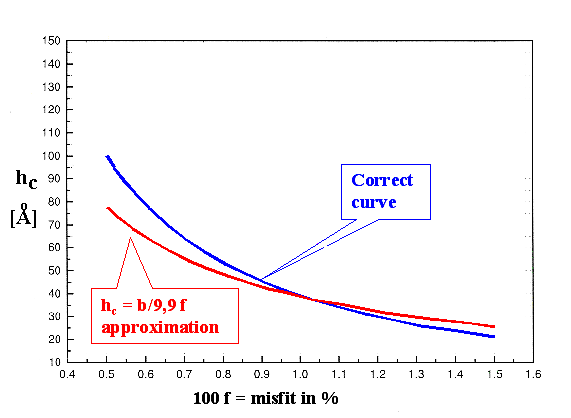
the comparison with the (computer-generated) correct functional dependence suggests |
| |
|
|
|
which is a bit different! |
|
A plot of the full formula and the approximation looks like this: |
| |
|
|
Similar curves are contained in the books of Mayer
and Lau or Tu, Mayer and Feldmann; they supposedly
use the same equation but show rather different results. |
| |
Well, somewhere should be a mistake (maybe I made one?). In any case, it nicely demonstrates the point
made in the backbone section: Do not blindly believe a theory. In
case of doubt, try it out. |
| | |
© H. Föll (Semiconductors - Script)
 With frame
 5.3.3 Real Heterojunctions