 |
The visible range of wavelengths extends from about 780 nm (red) to 380
nm (violet). Obviously we need to go to even smaller wavelengths in the ultraviolet part of the spectrum if we want
to make structures in the 100 nm region. Obvious, so where is the problem? Well, there are two major problems with
this approach. |
|
First, we need a powerful and fairly monochromatic
illumination source, and second we need materials to make an extremely good lens from.
|
|
Let's look at the illumination source issue first: |
|
 |
A powerful light source we need because we
cannot afford to wait forever before an exposure is finished. The maximum exposure time should be below a second or so,
and you simply need intense light for that. |
|
|
Monochromatic light we need, because we cannot
possible built a supreme lens for many wavelengths (there are things like chromatic aberration and so on). Taking a small
part of the spectrum out of some blackbody radiation (the spectrum emitted by something hot like a light bulb), however,
leaves very little intensity. |
|
The solution lies in going for an intense line in the emission spectrum of some
element - mercury (Hg) in this case. |
|
|
In the 80ties, the so-called G-line at 436 nm was used (coming
from a high-pressure Hg discharge lamp). Next came the I-line at 365 nm, and then a 250 nm line.
|
|
|
But that was already pushing the Hg lamp to its limits, and it was soon
replaced by so-called DUV (for deep ultraviolet) excimer
lasers. |
|
|
Excimer lasers are based on rather strange materials: Compounds of noble gases
like KrF, or ArF. Rather unstable stuff, but emitting at 248 nm (KrF) or 193 nm (ArF).
With the KrF system, dimensions down to 130 nm have been realized, but this is already pushing it quite a
bit. |
|
|
The ArF excimer laser has been used from about 2003, so it is still
in its infancy. It is expected to cover the "65 nm node", and possibly also the 45 nm node. |
|
|
That will be the end. After that, the age of "EUV" (extreme
ultraviolet) might start, at a wavelength around 12 nm (its really rather soft X-rays). There is no way of
having a lens anymore, "optical processing" must then be done with mirrors. |
|
If we now look at the lens issue, we first
should realize that high-aperture lenses are generally difficult to make. But the overwhelming issue is to find suitable
materials that have a sufficiently large index of refraction at the wavelength considered. |
|
|
We already looked at this issue, e.g. in the context of the frequency dependence
of the dielectric constant, so we need not repeat the problems encountered here. Check the following links: |
|
Illumination source and lens materials are not the only problems encountered by
switching to a smaller wavelength. Of course, there are many others, too. |
|
|
To mention just one: The "pellicles",
the thin foils protecting the mask, will turn dark in intense UV illumination. Not good, so let's take a better material.
Easy fix, but do you know a better material? No? Too bad - since nobody else does either, you missed your change of getting
rich quickly. |
| |
|
| |
In air, NA obviously than has a maximum value of 1. The best
lenses built so far have a NA of about 0.8; but 0.9 is already aimed for |
|
|
Keep in mind that what you gain in resolution by increasing NA,
you loose in the depth of focus. Large NA
lenses thus only make sense in the context of rather perfect planarization. |
|
Nevertheless, increasing NA even more helps, and there is - in principle
- a simple way of doing it: Replace the air between your lens and the wafer with something that has an appreciable index
of refraction, e.g. oil. |
|
|
"Oil immersion objective lenses" have been used for about a century
in conventional optical microscopes; in this way the numerical aperture and thus resolution can be increased in a rather
simple way by up to 40%. |
|
|
But this is far easier said than done. Just consider that the name "stepper" comes from the fact, that you step
the wafer (rather rapidly) below the lens. How do you keep you oil in place? And how will the wafer respond to be covered with oil?
|
|
|
Well, let's not use oil, let's use high-purity water (n = 1.437
at 193 nm), but that only solves some of many problems and creates some new one (your CaF2 lens,
for example, will dissolve in water). |
|
|
Nevertheless, "liquid immersion
lithography" will most likely be the next big fashion in lithography, with the potential to keep microelectronics
alive well into the next decade (i.e. after 2010). |
| | |
| |
What is left is to make the parameter k
as small as possible, i.e. to pay some attention to reticles and resist,
or, more general, to resolution enhancing techniques. |
|
|
There is quite a potential here, "historically" parameter k
has decreased steadily form about 0.8 in the 1980s to 0.4 today. |
|
|
While optimizing the resist is critical, it does not introduce new principles,
and we will not cover it here. |
|
|
That leaves the reticle and the way it is illuminated. There is quite a bit that
can be done, but you must pay the prize of sharp increases in complexity. |
| | |
| |
|
|
The proper catchwords giving some idea to what is meant are:
- Off-axis illumination
- Optical proximity correction (OPC)
- Phase shift masks (PSM)
|
| | |
|
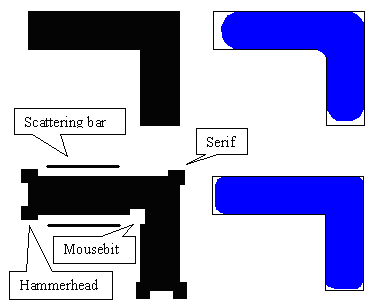
For the latter two cases the general idea is to have a structure on the reticle that is different
from what you want to have projected into the resist on the wafer. If, for example, a sharp corner is "smeared out"
to a roundish image, than make the corner look different. The figure gives a rough idea what that means |
| | |
|
In phase shift masks you add structures that do not only manipulate the amplitude of the light
transmitted through the mask, but also the phase. |
| | |
|
In this way you can produce constructive or destructive interference in the image plane in
places where that is helpful to sharpen the image. |
|
| |
|
Of course, all these additional features on the mask must first be computed (not
easy), than made (very difficult), and finally tested (exceedingly difficult). |
|
|
Testing your mask is essential, that any mistake in the mask will automatically
be transferred to the chip and, remember Murphy's law, more likely than not kill the chip. |
|
In the grand total a set of masks will quickly cost you up to 2.000.000 €.
You must a sell a hell of a lot of chips (at a profit) just to recover that cost |
|
|
For customized chips, that are not made by the untold millions, its simply not
possible to pay that prize. |
|
|
This drives a large-scale effort to find some better solutions. For mor details
(and for the source of some of the data here), refer to "Materials today" from Feb. 2005. |
| |
|
© H. Föll (Electronic Materials - Script)
 With frame
 6.6.2 Resist and Steppers