 |
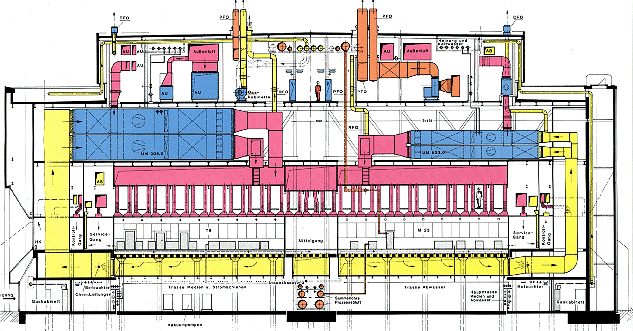
First. let's look at the cross-section of a typical "class 1" cleanroom. Class
1 means roughly that there will be at most 1 particle per foot3 (about 30 liters)
larger than 0,2 µm or so in the air. |
|
|
| |
.
|
|
| |
|
 |
If you click on the image, you will get a real big (702 kb) version where all the details
are shown. Anyway, even in the small illustration you can see that the "actual" cleanroom where people make chips,
is a small part of the building (the whitish portion just above the lower yellow part). |
| |
Everything colored is just for moving air around, keeping its temperature and humidity constant,
add some fresh air from the outside and to get rid of "spent" air. |
|
A particular interesting place in a cleanroom building is the "basement" right under
the actual cleanroom. It houses a large part of the "equipment", e.g. pumps, liquid and gas inlets, outlets, and
cleaning parts, transformers, power equipment, heaters etc. It also houses miles of tubing for delivering away and taking
gases and liquids. Some pictures: |
| |
 |
| Pumps and piping |
|
 |
| Water treatment |
|
© H. Föll (Electronic Materials - Script)
 5.3.1 Cleanrooms, Particles and Contamination
 With frame