|
The dielectric constant er "somehow"
describes the interaction of dielectric (i.e. more or less insulating) materials and electrical fields; e.g. via the equations
Þ | |
|
|
 |
D is the electrical displacement or electrical
flux density, sort of replacing E in the Maxwell equations whenever materials
are encountered. | |
|
|
C is the capacity of a parallel plate capacitor (plate area A,
distance d) that is "filled" with a dielectric with er |
|
|
|
n is the index of refraction; a quantity that "somehow" describes
how electromagnetic fields with extremely high frequency interact with matter.
in this equaiton it is assumed that the
material has no magnetic properties at the frequency of light. |
|
| |
| |
| |
|
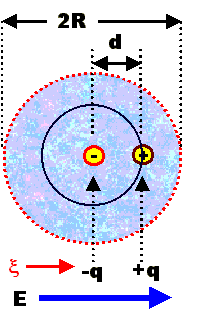
Electrical fields inside dielectrics polarize the material, meaning that the vector
sum of electrical dipoles inside the material is no longer zero. |
| |
|
|
The decisive quantities are the dipole moment µ, a vector, and the Polarization
P, a vector, too. | |
|
|
|
Note: The dipole moment vector points from the negative to the positive charge - contrary
to the electrical field vector! | |
|
|
The dipoles to be polarized are either already present in the material (e.g. in H2O
or in ionic crystals) or are induced by the electrical field (e.g. in single atoms or covalently bonded crystals like Si) |
|
|
|
The dimension of the polarization P is [C/cm2] and
is indeed identical to the net charge found on unit area ion the surface of a polarized dielectric. |
|
| |
| |
| |
|
The equivalent of "Ohm's law", linking current density to field strength
in conductors is the Polarization law: | |
|
|
|
The decisive material parameter is c ("kee"), the
dielectric susceptibility |
|
|
|
The "classical" flux density D and the Polarization are linked as
shown. In essence, P only considers what happens in the material, while D looks at the
total effect: material plus the field that induces the polarization. |
|
| |
| |
|
|
Polarization by necessity moves masses (electrons and / or atoms) around, this
will not happen arbitrarily fast. | |
|
|
|
er or c thus
must be functions of the frequency of the applied electrical field, and we want to consider the whole frequency range from
RF via HF to light and beyond. | |
| er(w) is called the "dielectric
function" of the material. |
|
|
The tasks are:
- Identify and (quantitatively) describe the major mechanisms of polarization.
- Justify the assumed linear relationship between P and c.
- Derive the dielectric function for a given material.
|
| |
| | |
| |
|
|
(Dielectric) polarization mechanisms in dielectrics are all mechanisms that
- Induce dipoles at all (always with µ in field direction)
Þ Electronic polarization.
- Induce dipoles already present in the material to "point" to some extent in field direction.
Þ Interface polarization.
Þ Ionic polarization.
Þ Orientation polarization. |
|
Quantitative considerations of polarization mechanisms yield
- Justification (and limits) to the P µ
E "law"
- Values for c
- c=c(w)
- c=c(structure)
|
|
| |
| |
|
Electronic polarization describes the separation of the centers of "gravity"
of the electron charges in orbitals and the positive charge in the nucleus and the dipoles formed this way. it is always
present | |
|
|
|
It is a very weak effect in (more or less isolated) atoms or ions with spherical
symmetry (and easily calculated). | |
|
|
It can be a strong effect in e.g. covalently bonded materials like Si (and not so easily
calculated) or generally, in solids. | |
| | |
| |
|
Ionic polarization describes the net effect of changing the distance between neighboring
ions in an ionic crystal like NaCl (or in crystals with some ionic component like SiO2) by the
electric field | |
|
|
|
Polarization is linked to bonding strength, i.e. Young's modulus Y. The effect is smaller
for "stiff" materials, i.e.
P µ 1/Y |
|
| |
| |
| |
|
Orientation polarization results from minimizing the free enthalpy of an ensemble
of (molecular) dipoles that can move and rotate freely, i.e. polar liquids. |
|
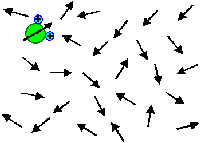 |
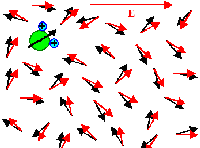 | | Without field | With field |
|
|
|
It is possible to calculate the effect, the result invokes the Langevin function |
|
|
| |
|
|
|
| |
| |
| |
| |
|
|
In a good approximation the polarization is given by Þ |
|
|
| | |
| |
|
|
The induced dipole moment µ in all mechanisms is proportional to the
field (for reasonable field strengths) at the location of the atoms / molecules considered. |
|
|
|
|
The proportionality constant is called polarizability a;
it is a microscopic quantity describing what atoms or molecules "do" in a field. |
|
|
|
The local field, however, is not identical to the macroscopic or external field, but can be
obtained from this by the Lorentz approach | |
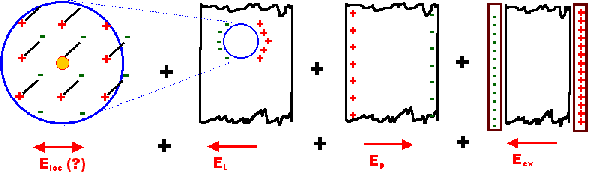 |
| Eloc = Eex + Epol
+ EL + Enear |
|
|
|
|
For isotropic materials (e.g. cubic crystals) one obtains |
|
|
|
| |
| |
| |
|
|
Knowing the local field, it is now possible to relate the microscopic quantity
a to the macroscopic quantity e or er
via the Clausius - Mosotti equations Þ |
|
N · a
3 e0 |
= |
er – 1
er + 2 | | |
| |
| = |
c
c + 3 |
|
|
|
|
While this is not overly important in the engineering practice, it is a momentous achievement.
With the Clausius - Mosotti equations and what went into them, it was possible for the first time to understand most electronic
and optical properties of dielectrics in terms of their constituents (=atoms) and their structure (bonding, crystal lattices
etc.) | |
|
|
Quite a bit of the formalism used can be carried over to other systems with dipoles involved,
in particular magnetism=behavior of magnetic dipoles in magnetic fields. |
|
| |
| |
| |
|
Alternating electrical fields induce alternating forces for dielectric dipoles.
Since in all polarization mechanisms the dipole response to a field involves the movement of masses, inertia will prevent
arbitrarily fast movements. | |
|
|
|
Above certain limiting frequencies of the electrical field, the polarization
mechanisms will "die out", i.e. not respond to the fields anymore. |
|
|
|
This might happen at rather high (=optical) frequencies, limiting the index of refraction
n=(er)1/2 |
|
| |
| |
|
|
The (only) two physical mechanisms governing the movement of charged masses experiencing
alternating fields are relaxation and resonance. | |
|
|
Relaxation describes the decay of excited
states to the ground state; it describes, e.g., what happens for orientation polarization after the field has been switched off.
| |
|
|
From the "easy to conceive" time behavior we deduce the frequency behavior by a
Fourier transformation | |
|
|
The dielectric function describing relaxation has a typical frequency dependence in its real
and imaginary part Þ |
|
|
| |
| |
|
Resonance describes anything that can be modeled as a mass on a spring - i.e.
electronic polarization and ionic polarization. | |
|
|
|
The decisive quantity is the (undamped) resonance frequency w
0=( kS/ m)½ and the "friction" or damping constant
kF | |
|
|
The "spring" constant is directly given by the restoring forces between charges,
i.e. Coulombs law, or (same thing) the bonding. In the case of bonding (ionic polarization) the spring constant is also
easily expressed in terms of Young's modulus Y. The masses are electron or atom masses for electronic or ionic
polarization, respectively. | |
|
|
The damping constant describes the time for funneling off ("dispersing") the energy
contained in one oscillating mass to the whole crystal lattice. Since this will only take a few oscillations, damping is
generally large. | |
|
|
The dielectric function describing relaxation has a typical frequency dependence in its real
and imaginary part Þ
The green curve would be about right for crystals. |
|
| |
| |
|
|
The complete frequency dependence of the dielectric behavior of a material, i.e.
its dielectric function, contains all mechanisms "operating" in that material. |
|
|
|
|
As a rule of thumb, the critical frequencies for relaxation mechanisms are in theGHz
region, electronic polarization still "works" at optical (1015 Hz) frequencies (and thus is
mainly responsible for the index of refraction). | |
|
|
Ionic polarization has resonance frequencies in between. |
|
|
|
Interface polarization may "die out" already a low frequencies. |
|
|
A widely used diagram with all mechanisms shows this, but keep in mind that there
is no real material with all 4 major mechanisms strongly present!
Þ |
|
| |
| |
|
|
A general mathematical theorem asserts that the real and imaginary part of the
dielectric function cannot be completely independent | |
|
e'(w) = |
– 2 w
p | |
¥
ó
õ
0 | |
w* · e''(w*)
w*2– w2 |
· dw* |
|
e''(w) = |
2 w
p
| |
¥
ó
õ
0 | |
e'(w*)
w*2– w2 |
· dw* |
|
|
|
|
|
If you know the complete frequency dependence of either the real or the imaginary part, you
can calculate the complete frequency dependence of the other. |
|
|
|
This is done via the Kramers-Kronig relations; very useful and important equations in material
practice.
Þ | |
| | |
| |
|
|
The frequency dependent current density j flowing through a dielectric
is easily obtained. Þ | |
| j(w) = |
dD
dt |
= e(w) ·
| dE
dt
|
= w · e'' ·
E(w) | + |
i · w · e' · E(w) | | |
| |
|
in phase |
|
out of phase |
|
|
|
|
The in-phase part generates active power and thus heats up the dielectric, the
out-of-phase part just produces reactive power | |
|
|
The power losses caused by a dielectric are thus directly proportional to the imaginary component
of the dielectric function | |
| |
| LA |
=
|
power turned
into heat |
= w · |e''| · E2 |
|
| |
|
| |
| |
|
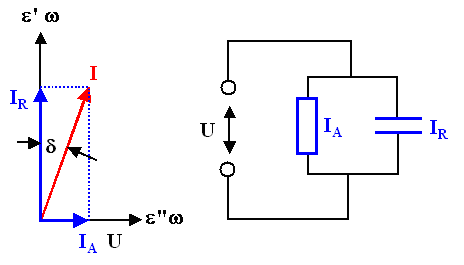
The relation between active and reactive power is called "tangens Delta"
(tg(d)); this is clear by looking at the usual pointer diagram of the current |
|
|
| |
LA
LR |
:= | tg d |
= | IA
IR | = |
e''
e' |
|
| |
|
| | |
| |
|
The pointer diagram for an ideal dielectric s(w=0)=0can always be obtained form an (ideal) resistor R(w)
in parallel to an (ideal) capacitor C(w). |
|
|
|
R(w) expresses the apparent conductivity sDK(w) of the dielectric, it follows that |
|
|
|
| |
| |
| |
| |
|
For a real dielectric with a non-vanishing
conductivity at zero (or small) frequencies, we now just add another resistor in parallel. This allows to express all conductivity effects of a real dielectric in the imaginary part of its (usually measured)
dielectric function via | |
|
|
|
We have no all materials covered with respect to their
dielectric behavior - in principle even metals, but then resorting to a dielectric function would be overkill. |
|
|
| | |
|
|
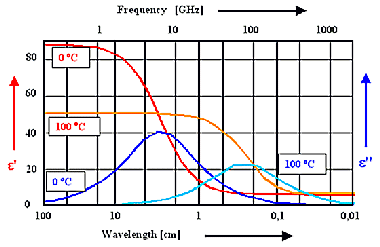
A good example for using the dielectric function is "dirty" water with
a not-too-small (ionic) conductivity, commonly encountered in food. | |
|
|
|
The polarization mechanism is orientation polarization, we expect large imaginary parts of
the dielectric function in the GHz region. | |
|
|
It follows that food can be heated by microwave (ovens)! |
|
| |
| |
|
|
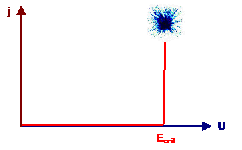
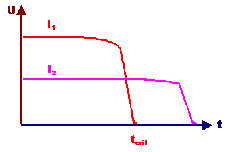
The first law of materials science obtains: At field strengths larger than some
critical value, dielectrics will experience (destructive) electrical breakdown |
|
|
|
|
This might happen suddenly (then calls break-down) , with a bang and smoke, or |
|
|
|
it may take time - months or years - then called failure. |
|
|
|
Critical field strength may vary from < 100 kV/cm to > 10 MV / cm. |
| |
| | |
| |
|
Highest field strengths in practical applications do not necessarily occur at
high voltages, but e.g. in integrated circuits for very thin (a few nm) dielectric layers |
|
Example 1: TV set, 20 kV cable, thickness of insulation=2 mm. Þ
E=100 kV/cm
Example 2: Gate dielectric in transistor, 3.3 nm thick, 3.3 V operating voltage. Þ
E=10 MV/cm |
|
|
|
Properties of thin films may be quite different (better!) than bulk properties! |
|
|
| | |
|
|
Electrical breakdown is a major source for failure of electronic products (i.e.
one of the reasons why things go "kaputt" (=broke)), but there is no simple mechanism following some straight-forward
theory. We have: | | |
|
|
Thermal breakdown; due to small (field dependent) currents
flowing through "weak" parts of the dielectric. | |
|
|
|
Avalanche breakdown due to occasional free electrons being accelerated in the field;
eventually gaining enough energy to ionize atoms, producing more free electrons in a runaway avalanche. |
| |
|
|
Local discharge producing micro-plasmas in small cavities,
leading to slow erosion of the material. | |
|
|
|
Electrolytic breakdown due to some ionic micro conduction
leading to structural changes by, e.g., metal deposition. | |
|
| |
| |
| |
|
Polarization P of a dielectric material can also be induced
by mechanical deformation e or by other means. | |
|
|
|
Piezo electric materials are anisotropic
crystals meeting certain symmetry conditions like crystalline quartz (SiO2): the effect is linear. |
|
|
|
The effect also works in reverse: Electrical fields induce mechanical deformation |
|
|
|
Piezo electric materials have many uses, most prominent are quartz oscillators and, recently,
fuel injectors for Diesel engines. | |
| | |
| |
|
Electrostriction
also couples polarization and mechanical deformation, but in a quadratic way and only in the direction "electrical
fields induce (very small) deformations". | |
|
|
|
The effect has little uses so far; it can be used to control very small movements, e.g. for
manipulations in the nm region. Since it is coupled to electronic polarization, many materials show this effect. |
|
|
| | |
|
|
Ferro electric materials posses a permanent
dipole moment in any elementary cell that, moreover, are all aligned (below a critical temperature). |
|
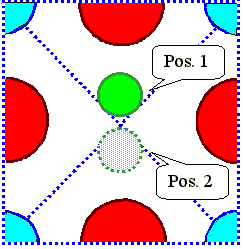 |
| BaTiO3unit cell |
|
|
|
There are strong parallels to ferromagnetic materials (hence the strange name). |
|
|
|
Ferroelectric materials have large or even very large (er
> 1.000) dielectric constants and thus are to be found inside capacitors with high capacities (but not-so-good high
frequency performance) | |
| |
| |
| |
|
Pyro electricity couples polarization to temperature
changes; electrets are materials with permanent polarization, .... There are more "curiosities"
along these lines, some of which have been made useful recently, or might be made useful - as material science and engineering
progresses. | | |
| | |
| |
|
|
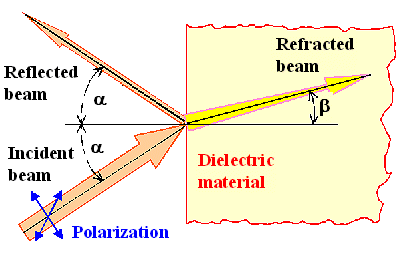
The basic questions one would like to answer with respect to the optical behaviour
of materials and with respect to the simple situation as illustrated are:
- How large is the fraction R that is reflected? 1 – R then will be going in the material.
- How large is the angle b, i.e. how large is the refraction of the material?
- How is the light in the material absorped, i.e. how large is the absorption coefficient?
|
|
|
|
|
Of course, we want to know that as a function of the wave length l
or the frequency n=c/l, the angle a,
and the two basic directions of the polarization ( | |
| | |
| |
|
All the information listed above is contained in the complex index of refraction
n* as given Þ | |
|
| Basic definition of
"normal" index of refraction n |
|
| Terms used for complex index of refaction n*
n=real part
k=imaginary part |
| n*2=(n + ik)2 = e'
+ i · e'' |
| Straight forward definition of n* |
|
| | |
| |
|
|
Working out the details gives the basic result that
- Knowing n=real part allows to answer question 1 and 2 from above via "Fresnel laws"
(and "Snellius' law", a much simpler special version).
- Knowing k=imaginary part allows to answer question 3
Þ
| |
| Ex = | exp – |
w · k · x
c
|
· exp[ i · (kx · x – w
· t)] | | | | | | | |
Amplitude:
Exponential
decay with k |
"Running" part of
the wave |
|
|
| | |
| |
|
Knowing the dielectric function of a dielectric material (with the imaginary part
expressed as conductivity sDK), we have (simple) optics completely covered! |
|
| n2 | = |
1
2 |
æ
ç
è |
e' | + |
æ
è |
e' 2 + |
sDK2
4e02w2 |
ö
ø |
½ |
ö
÷
ø |
| k2 | = |
1
2 |
æ
ç
è |
– e' | + |
æ
è |
e' 2 + |
sDK2
4e02w2 |
ö
ø |
½ |
ö
÷
ø |
|
|
|
|
If we would look at the tensor properties of e, we would
also have crystal optics (=anisotropic behaviour; things like birefringence) covered. |
|
|
|
We must, however, dig deeper for e.g. non-linear optics ("red in - green (double frequency)
out"), or new disciplines like quantum optics. | |
| |
|
© H. Föll (Electronic Materials - Script)