 |
Polarization P of a dielectric material can also be induced
by mechanical deformation e or by other means. | |
|
|
 |
Piezo electric materials are anisotropic
crystals meeting certain symmetry conditions like crystalline quartz (SiO2): the effect is linear. |
|
|
|
The effect also works in reverse: Electrical fields induce mechanical deformation |
|
|
|
Piezo electric materials have many uses, most prominent are quartz oscillators and, recently,
fuel injectors for Diesel engines. | |
| | |
| |
|
Electrostriction
also couples polarization and mechanical deformation, but in a quadratic way and only in the direction "electrical
fields induce (very small) deformations". | |
|
|
|
The effect has little uses so far; it can be used to control very small movements, e.g. for
manipulations in the nm region. Since it is coupled to electronic polarization, many materials show this effect. |
|
|
| |
| |
|
Ferro electric materials posses a permanent
dipole moment in any elementary cell that, moreover, are all aligned (below a critical temperature). |
|
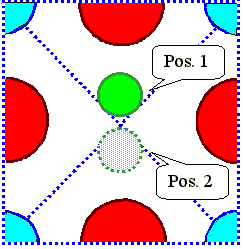 |
| BaTiO3 unit cell |
|
|
|
There are strong parallels to ferromagnetic materials (hence the strange name). |
|
|
|
Ferroelectric materials have large or even very large (er
> 1.000) dielectric constants and thus are to be found inside capacitors with high capacities (but not-so-good high
frequency performance) | |
| | |
| |
|
|
Pyro electricity couples polarization to temperature
changes; electrets are materials with permanent polarization, .... There are more "curiosities"
along these lines, some of which have been made useful recently, or might be made useful - as material science and engineering
progresses. | | |
| | |
|
© H. Föll (Electronic Materials - Script)


