|
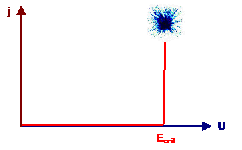
The first law of materials science obtains: At field strengths larger than some
critical value, dielectrics will experience (destructive) electrical breakdown |
|
|
|
 |
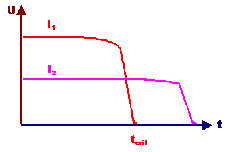
This might happen suddenly (then calls break-down) , with a bang and smoke, or |
|
|
|
it may take time - months or years - then called failure. |
|
|
|
Critical field strength may vary from < 100 kV/cm to > 10 MV / cm. |
| |
| | |
| |
|
Highest field strengths in practical applications do not necessarily occur at
high voltages, but e.g. in integrated circuits for very thin (a few nm) dielectric layers |
|
Example 1: TV set, 20 kV cable, thickness of insulation = 2 mm. Þ
E = 100 kV/cm
Example 2: Gate dielectric in transistor, 3.3 nm thick, 3.3 V operating voltage. Þ
E = 10 MV/cm |
|
|
|
Properties of thin films may be quite different (better!) than bulk properties! |
|
|
| |
| |
|
Electrical breakdown is a major source for failure of electronic products (i.e.
one of the reasons why things go "kaputt" (= broke)), but there is no simple mechanism following some straight-forward
theory. We have: | | |
|
|
Thermal breakdown; due to small (field dependent) currents
flowing through "weak" parts of the dielectric. | |
|
|
|
Avalanche breakdown due to occasional free electrons being accelerated in the field;
eventually gaining enough energy to ionize atoms, producing more free electrons in a runaway avalanche. |
| |
|
|
Local discharge producing micro-plasmas in small cavities,
leading to slow erosion of the material. | |
|
|
|
Electrolytic breakdown due to some ionic micro conduction
leading to structural changes by, e.g., metal deposition. | |
|
| |
|
|
© H. Föll (Electronic Materials - Script)