|
The frequency dependence of the electronic and ionic polarization mechanisms are
mathematically identical - we have a driven oscillating system with a linear
force law and some damping. In the simple classical approximation used so far, we may use the universal equation describing
an oscillating system driven by a force with a sin(wt) time dependence |
| |
| m · |
d2x
dt2 |
+ kF · m · |
d x
d t |
+ ks · x |
= |
q · E0 · exp (i w
t) |
|
|
|
 |
With m = mass, kF =
friction coefficient; describing damping, kS =
"spring" coefficient or constant; describing the restoring force, q · E0 =
amplitude times charge to give a force , E = E0· exp (iw
t) is the time dependence of electrical field in complex notation. |
|
|
This is of course a gross simplification: In the equation above we look at one
mass m hooked up to one spring, whereas a crystal consists of a hell of
a lot of masses (= atoms), all coupled by plenty of springs (= bonds). Nevertheless, the analysis of just one oscillating
mass provides the basically correct answer to our quest for the frequency dependence of the ionic and atomic polarization.
More to that in link. |
|
We know the "spring"
coefficient for the electronic and ionic polarization mechanism; however, we do not know from our simple consideration
of these two mechanisms the "friction" term. |
| |
So lets just consider the general solution to the differential equation given above in terms of the general
constants kS and kF and see what kind of general conclusions we can draw. |
|
From classical mechanics we know that the
system has a resonance frequency w0, the frequency with the maximum amplitude
of the oscillation, that is (for undamped oscillators) always given by |
|
|
| w 0 | =
| æ
ç
è |
kS
m |
ö
÷
ø | 1/2 |
|
|
|
|
The general solution of the differential equation is |
| |
| x(w ,t) = x(w
) · exp (iwt + f) |
|
|
|
|
The angle f is necessary because there might be some phase
shift. This phase shift, however, is automatically taken care of if we use a complex amplitude. The complex x(w ) is given by |
| |
| x(w ) = |
q · E0
m
| æ
ç
è |
æ
è |
w02 – w2
(w 02 – w
2)2 + kF2 w 2 |
ö
ø |
– i · |
æ
è |
kF
w
(w
02 – w
2)2 + kF2 w 2
|
ö
ø |
ö
÷
ø |
|
|
|
|
x(w ) indeed is a complex function,
which means that the amplitude is not in phase with the driving force if the imaginary part is not zero. |
|
Again, we are interested in a relation between the sin components of the polarization
P(w) and the sin components of the driving field E = E0·exp
(iwt) or the dielectric flux D(w) and the
field. We have |
|
|
| P | = |
N · q · x(w ) |
| | |
| | | |
| | |
| | | D |
= |
e0 · er · E |
= |
e0 · E + P |
= |
e0 · E + N · q · x(w ) |
|
|
|
If we insert x(w) from the solution given above, we
obtain a complex relationship between D and E |
|
|
| D = |
æ
ç
è |
e0 + |
N · q2
m
| æ
ç
è |
æ
è |
w02 – w2
(w
02 – w
2)2 + kF2 w 2
| ö
ø |
– i |
æ
è |
kF
w
(w
02 – w2)2 + kF2
w 2
|
ö
ø |
ö
÷
ø |
ö
÷
ø |
· E |
|
|
|
|
This looks pretty awful, but it encodes basic everyday knowledge! |
|
This equation can be rewritten using the dielectric
function
defined before with the added generalization that we now define it for the permittivity, i.e, for
|
|
|
| e(w) |
= |
er(w ) · e0
| = |
e'(w) – i ·
e''(w) |
|
|
|
|
For the dielectric flux D, which we prefer in this
case to the polarization P, we have as always |
|
|
| D(w, t) | =
|
[e'(w ) – i · e''(w )] · E0 · exp (iw t) |
|
|
|
|
The time dependence of D is simple given by exp (iw
t), so the interesting part is only the w - dependent factor. |
|
Rewriting the equations for the real and imaginary part of e
we obtain the general dielectric function for resonant polarization mechanisms: |
| |
| e' = |
e0 + |
N · q2
m | |
æ
ç
è |
w02 – w2
(w 02 – w
2)2 + kF2 · w2
| ö
÷
ø |
| | |
| |
| |
|
| e'' = |
| N · q2
m
| |
æ
ç
è |
kF · w
(w
02 – w
2)2 + kF2 · w2 |
ö
÷
ø |
|
|
| |
These formula describe the frequency dependence of the dielectric constant of
any material where the polarization mechanism is given by separating charges with mass
m by an electrical field against a linear restoring force. |
|
|
For the limiting cases we obtain for the real and imaginary part
|
| |
| e'(w = 0) |
= | æ
ç
è
| e0 + |
N · q2
m |
ö
÷
ø |
| 1
w 02 | = |
æ
ç
è |
e0 + |
N · q2
m | ö
÷
ø |
| m
kS | | | |
| | |
| | |
| | |
| | |
|
| e'(w = ¥) |
= |
e0 |
| | |
| | |
| | |
| |
|
|
|
|
For e'(w = ¥)
we thus have er = e'/e0
= 1 as must be. |
|
The most important material parameters for dielectric constants at the low frequency limit,
i.e. w
Þ 0, are therefore the masses
m of the oscillating charges, their "spring" constants
kS, their density
N, and the charge q on the ion considered. |
|
|
We have no big problem with these parameters, and that includes the "spring"
constants. It is a direct property of the bonding situation and in principle we know how to calculate its value. |
|
|
The friction constant kF does not appear in the limit values of e.
As we will see below, it is only important for frequencies around the resonance frequency. |
|
For this intermediate case kF is the difficult parameter. On the atomic
level, "friction" in a classical sense is not defined, instead we have to
resort to energy dispersion mechanisms. While it is easy to see how this works, it is
difficult to calculate numbers for kF. |
|
|
Imagine a single oscillating dipole in an ionic crystal. Since the vibrating ions are coupled to their
neighbours via binding forces, they will induce this atoms to vibrate, too - in time the whole crystal vibrates. The ordered
energy originally contained in the vibration of one dipole (ordered, because it vibrated
in field direction) is now dispersed as unordered thermal energy throughout the crystal. |
|
|
Since the energy contained in the original vibration is constant, the net effect on the single oscillating
dipole is that of damping because its original energy is now spread out over many atoms.
Formally, damping or energy dispersion can be described by some fictional "friction" force. |
| |
Keeping that in mind it is easy to see that all mechanisms, especially interaction with phonons, that convert
the energy in an ordered vibration in field direction to unordered
thermal energy always appears as a kind of friction force on a particular oscillator. Putting a number on this
fictional friction force, however, is clearly a different (and difficult) business. |
| |
However, as soon as you realize that the dimension of kF is 1/s and that
1/kF simply is about the time that it takes for an oscillation to "die", you can start
to have some ideas - or you check the link. |
| |
Now lets look at some characteristic behavior and some numbers as far as we can
derive them in full generality. |
|
|
For the electronic polarization mechanism, we know
the force constant, it is |
| |
|
|
|
With the proper numbers for a hydrogen atom we obtain |
|
|
|
|
|
This is in the ultraviolet region of electromagnetic radiation.
For all other materials we would expect similar values because the larger force constants ((ze)2
overcompensates the increasing size R) is balanced to some extent by the larger mass. |
| |
For the ionic polarization mechanism, the masses are several thousand
times higher, the resonance frequency thus will be considerably lower. It is, of course simply the frequency of the general
lattice vibrations which, as we know, is in the
1013 Hz range |
|
This has an important consequence: |
| |
The dielectric constant at frequencies higher than about the frequency corresponding to the UV part
of the spectrum is always 1. And since the optical index of refraction n is directly
given by the DK (n = e
1/2), there are no optical lenses beyond the UV part of the spectrum. |
| |
In other words: You can not built a deep-UV or X-ray microscope with lenses, nor - unfortunately
- lithography machines for chips with smallest dimension
below about 0,2 µm. For the exception to this rule see the footnote
from before. |
|
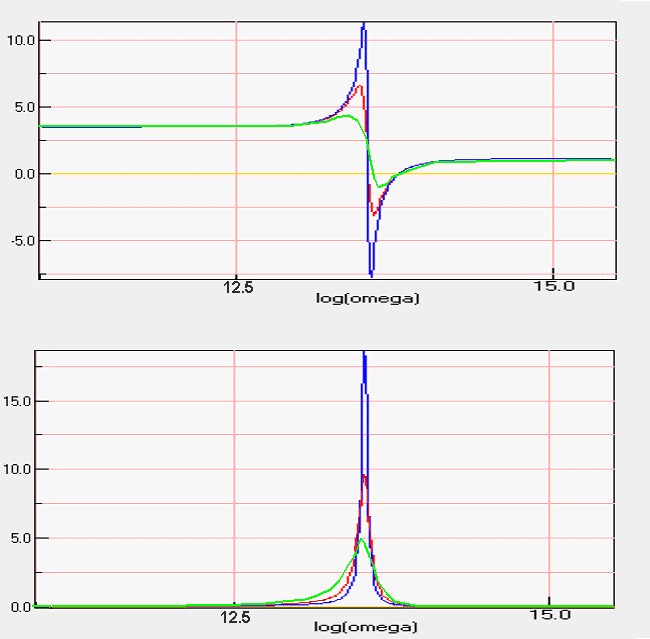
If we now look at the characteristic behavior of w ' and
w '' we obtain quantitatively the following curves (by using the JAVA
module provided for in the link): |
| |
|
|
|
Note that w is again
on a logarithmic scale! |
© H. Föll (Electronic Materials - Script)