 |
The discovery of high temperature superconductors in 1986 immediately lead to proposals
to use these materials for interconnects on chips instead of the Al that was common than (and for about 15
more years). |
|
 |
The reason was that the finite resistivity of Al together with parasitic capacitances
(e.g. between two conducting lines on a chip) limits the maximum frequency to
|
| |
|
|
|
With R = resistance of the longest connection line on the chip and C = parasitic
capacitance "seen" by this line. |
|
|
For R = 0 W as we have it for a superconductor, the maximum frequency
is no longer limited by R · C, no matter how large the parasitic capacitances are. Instead, the limit
comes from
fmax
= (L · C)–1/2
with L = inductance of the line, and this is just
another way of saying that the signal propagation is limited by the speed of light. |
| |
|
|
Given the resistivity of Al (at room temperature!), a sizeable advantage was seen for
the integrated circuits then envisioned. |
|
|
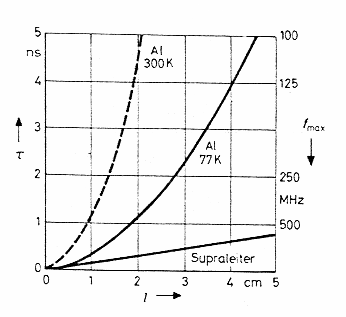
However, comparing the performance of a chip run with Al at room temperature to a chip run at liquid
N2 temperature (77 K), is not the right comparison. After all, you can cool down the conventional
chip, too - and that will decrease RAl by a factor of 6 - 8. |
| |
The comparison then is quite different. The graph shows the minimum switching time t
= 1/fmax as a function of the length of a standard interconnect line about 1 µm2
cross section. |
|
Whereas superconductors would already make an interesting difference for lengths of a few mm
(typical line length) in the wrong comparison, the correct comparison only shows an
advantage for about 1 cm and larger - line lengths easily avoided by clever design. |
|
|
© H. Föll (Electronic Materials - Script)
 With frame
 2.1.1 Conductors