|
Grain boundaries may contain special defects that only
exist in grain boundaries; the most prominent ones are grain boundary dislocations.
Grain boundary dislocations are linear defects with all the characteristics of lattice dislocations, but with very specific
Burgers vectors that can only occur in grain boundaries. |
|
 |
To construct grain boundary dislocations, we can use the universal Volterra definition.We start with a "low S" boundary and make a cut
in the habit plane of the boundary. The cut line, as before, will define the dislocation line vector l which
by definition will be contained in the boundary. |
|
|
Now we displace one grain with respect to the other grain by the Burgers vector b
so as to preserve the structure of the boundary everywhere except around the dislocation
line. In other words: the structure of the boundary after the shift looks exactly as before the shift. |
|
What does that mean? What is the "structure of the boundary" and how
do we preserve it? |
|
|
Well, we have a CSL on both sides of the boundary. We certainly will preserve the structure
of the boundary if we shift by a translation vector of the CSL, i.e. by a rather large Burgers vector. We than would
preserve the coincidence site lattice - which is fine, but far too limited. We already
preserve the structure of the boundary if we simply preserve the coincidence! |
|
|
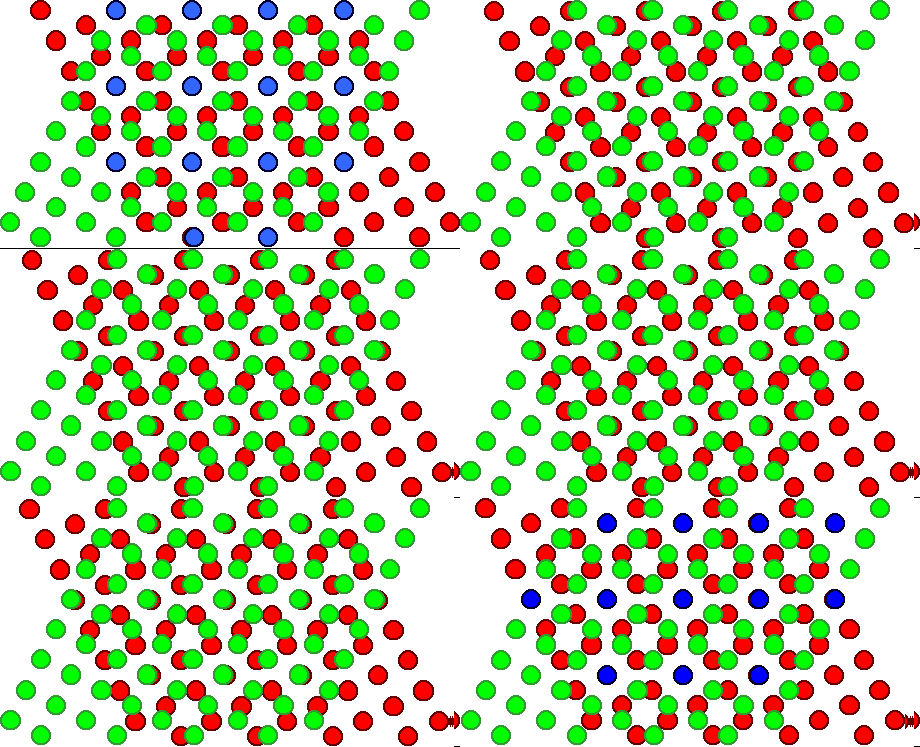
It is best to illustrate what this means with a simple animation:
Two superimposed lattices form a CSL marked in blue. The red lattice moves to
the left, and at first there are no more coincidences of lattice points - the CSL has disappeared and we have a different
structure. However, after a short distance of shifting - far smaller than a lattice vector of the CSL, coincidence
points appears and we have a CSL again - but with the coincidence points
now in different positions. |
| |
|
|
|
We found a displacement vector that preserved the structure of the boundary - sort of experimentally.
There are others, too, and the possible displacements vectors that conserve the CSL obviously are not limited to
vectors of the crystal lattice; they can be much smaller. This we can generalize: |
|
The set of all possible displacement vectors which preserve the
CSL defines a new kind of lattice, the so-called DSC-lattice.
The abbreviation "DSC" stands for "Displacement Shift Complete",
not the best of possible names, but time-honored by now. |
|
|
A better way of thinking about it would be to interprete the abbreviation as "Displacements which are Symmetry Conserving". Displacing one grain of a grain boundary with
a CSL by a vector of the corresponding DSC lattice thus preserves the structure of the boundary because it preserves
the symmetries of the CSL. We now conclude: |
|
|
Translation vectors of the DSC lattice are possible Burgers
vectors bGB for grain boundary dislocations. As for lattice dislocations, only the smallest
possible values will be encountered for energetic reasons. |
|
|
Grain boundary dislocations constructed in this way by
(Volterra) definition, have most of the properties of real dislocations - just with the added restriction that
they are confined to the boundary. Strain- and stress field, line energy, interactions, forming of networks - everything
follows the same equations and rules that we found for lattice dislocations. |
|
|
It remains to be seen how the DSC-lattice can be constructed. From the illustration
it is clear that every vector that moves a lattice site of grain 1 to a lattice site of grain 2 is a DSC-lattice
vector. This leads to a simple "working" definition: |
|
The
DSC-lattice is the coarsest sub-lattice of the CSL that has all
atoms of both lattices on its lattice points. Most lattice points of the DSC-lattice,
however, will be empty |
|
|
|
|
| |
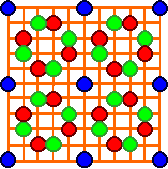
This is the DSC-lattice for the animation above. Its easy enough to obtain, but: |
|
A formal and general definition of the DSC lattice (including near CSL orientations)
is one of the most difficult undertakings in grain boundary theory. If you love tough nuts, turn to chapter
7.3 and proceed. |
| |
| | |
|
|
Any translation of one of the two crystals along a vector of the orange DSC-lattice will keep
the CSL, but will generally shift its origin. Only if a DSC vector is chosen that is also a vector of the
CSL, will the origin of the CSL remain in place. |
|
|
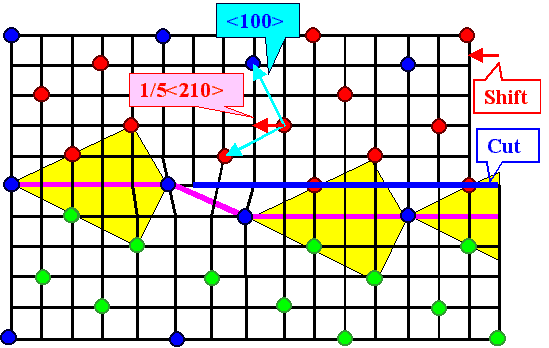
Looking back at the S5
boundary from before, we now can enact the cut and the displacement procedure and generate a picture of the dislocations
that must result. The result contains a little surprise and is shown in cross-section below: |
| |
|
|
|
The cut was made from the right. The top crystal (red lattice points) was shifted by a unit
vector of the DSC lattice, which is a 1/5<210> vector in both crystal lattices in this case. The second
crystal (green lattice points) was left completely unchanged. The coincidence points are blue. We observe two somewhat surprising
effects: |
|
|
The boundary plane (as indicate by the pink line) after the shift is not identical with the
plane of the cut |
|
|
The CSL has an interruption in both grains - it doesn't fit anymore. Disturbing - but totally unimportant. The CSL, after all, is totally
meaningless for real crystals - the (mathematical) coincidence points in the grains
have no significance for the grains. The only significance of a coincidence orientation
is that it provides an especially good fit of the two grains at a boundary, i.e. it allows for a particularly favorable
boundary structure. And the structure of the grain
boundary is unchanged by the introduction of the grain boundary dislocation, except around its core region. This is indicated
by the characteristic diamond shapes (yellow) in the picture above that can be taken as the hallmark of this S5
structure. |
|
|
Think about it! Finding the yellow diamonds is the practical way of finding the position of
the boundary. However you define the position - you will find the preserved structure as expressed in the yellow diamonds
here. |
|
|
Introducing the grain boundary dislocation thus had the unexpected additional
effect of introducing a step in the grain boundary. Some atoms had
to be changed from green to red to obtain the structure, but that again is an artifact
of the representation. Real atoms are all the same; they do not come in green and red and do not care to which
crystal they belong. |
|
We see that the recipe works: Dislocations in the DSC lattice preserve
the structure of the boundary; they leave the coincidence relation unchanged. However,
they also may introduce steps in the plane of the boundary -we cannot yet be sure that this always the case.
|
|
|
Note that is not directly obvious how the step relates to the dislocation, i.e.
how the vector describing the step can be deduced from the DSC lattice vector used as Burgers vector. (If you see
an obvious relationship - please tell me. I'm not aware of a simple formula applicable in all cases). |
|
|
Note also: While many (if not all) grain boundary dislocations are linked with
a step, the reverse is not true: There are many possible steps in a boundary that do not have any
dislocation character. More to that in chapter 8.3 |
|
The extension to three dimensions is obvious,
but also a bit mind-boggling. Still, some general rules can be given |
|
|
The larger the elementary cell of the CSL, the smaller the elementary cell of the DSC-lattice! |
|
|
If you suspected it by now: The DSC lattice is the reciprocal lattice (in space) of
the CSL. |
|
|
The volumes of CSL, crystal lattice and DSC lattice relate as S
: 1 : S –1 for cubic crystals. |
|
What are all these lattices good for? The main import is: |
|
|
A grain boundary between two grains that is close
to, but not exactly at a low-energy (=low S) orientation may decrease its energy
if grain boundary dislocations with a Burgers vector of the DSC lattice belonging to the low-S
orientation are introduced so that the dislocation free parts are now in the precise CSL
orientation and all the misalignment is taken up by the grain boundary dislocations. |
|
|
We will see how this works in the next sub-chapter. |
© H. Föll (Defects - Script)