 |
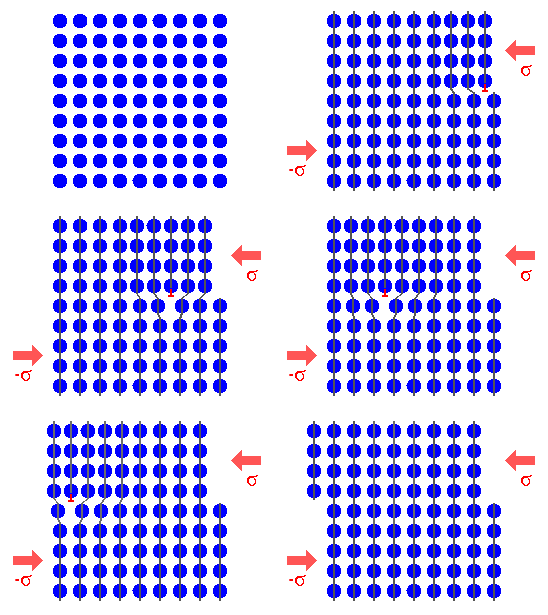
Here is an animation giving a schematic view
of the movement of an edge dislocation through a crystal. |
|
|
|
Dislocations move in response to an external stress s.
A |
|
 |
As soon as a critical shear stress
is reached, the dislocation starts moving and deformation is no longer elastic but plastic, because the dislocation will
not move back when the stress is removed. |
|
|
The example shows the movement of an idealized edge dislocation in a cubic primitive lattice
(which does not exist in nature). The grey lines show the projection of the lattice planes, the dislocation line (red symbols)
is perpendicular to the screen and bounds the extra lattice plane. |
|
|
The dislocation line moves on its glide plane and produces,
upon leaving the crystal (and thus disappearing), an elementary step on the crystal surface. Note that after the dislocation
disappeared, the crystal is completely stressfree. |
|
|
For macroscopic deformation in three dimensions, many
dislocations have to move through the crystal. The elementary process shown above thus has to be repeated literally billions
of times on many (at least 5) different planes of the lattice. |
| | |
© H. Föll (Defects - Script)
 With frame
 5.1.1 Dislocations