|
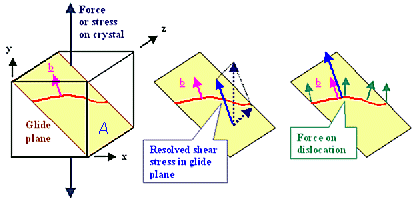
Around a dislacotion is a displacement field
(= vector field) , which defines a strain field (= tensor field), which gives cause
to a stress field (= tensor field) via elastic relations.
Stress times strain give the (potential) energy contained in these fields and thus the
energy of a dislocation; derivatives of energy with respect to coordinates give forces acting on dislocations | |
 |
| uz | = |
b · q
2p
| = |
b
2p |
· tan–1(y/x) | = |
b
2p |
· arctan (y/x) |
|
|
|
 |
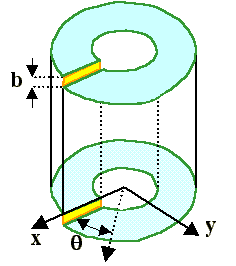
The displacement field
u(x,y, z) can be obtained by just looking hard at the dislocation - then write
it down. | |
|
|
The rest is just Math - not all that easy, but not reyll difficult either. |
|
|
In cylinder coordinates (r, q, z)
rather simple expressions for the stress and the strain result but with the two major problems emerging as soon as we look
at the energy per unit length of., e.g. a screw dislocation: |
|
|
| |
|
|
|
| Eel(screw) | = |
G · b2
4p |
· | ¥
ó
õ
0 | | dr
r |
|
| |
|
| |
|
|
|
Both boundaries lead to infinte energy values! |
|
|
| | |
|
|
The first problem comes from overextending elastic theory, only good at small
deformations, to the core region of the dislocation, the second one because the strain decreases so slowly that it is still
felt far away form the dislcotion. | |
| Eel | = |
G · b2
4p |
· | R
ó
õ
ro | dr
r |
+ Ecore »
|
G · b2
4p(1 –n )
| · | æ
ç
è
| ln | e · R
b |
ö
÷
ø |
|
|
|
|
The problem gets repaired by defining an inner and outer cut-off radius ro
and R, respectively, adding some core energy Ecore, worrying a lot if you are given
to it, and finally coming out with an extermely simple, usually good enough, and very important approximation for the energy
per length unit |b| | |
| | |
| |
| |
| |
|
| | |
|
|
Putting numbers into the equation gives several eV per unit length |b|
and thus tells us that dislocations tend to be straight lines (shortest possible length!). |
|
| |
| |
| |
© H. Föll (Defects - Script)