


t = 0 changes to u0 = E/kT0
t = ¥ changes to u = ¥.
This gives us
|
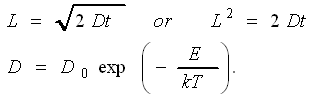
For the diffusion length L we have the well known equations: | |
|
||
|
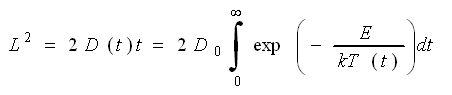
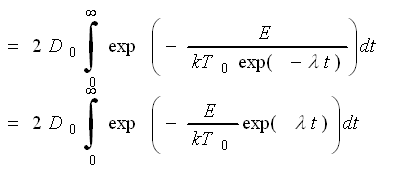
E is the activation energy of the diffusing species an k is the Boltzmann constant. Because of T = T0 · exp –(l · t) we obtain for L2 | |
|
| ||
|
Now we have a purely mathematical exercise which is not too difficult, but not too easy either. In order to solve the integral, we try the substitution | |
|
|
|
|
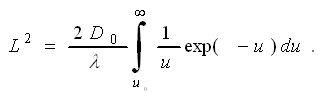
The boundaries must be changed too, we obtain t = 0 changes to u0 = E/kT0 t = ¥ changes to u = ¥. This gives us | |
|
||
|
Now you must solve a simple looking integral. There are several ways of doing that | ||||||||||
|
| ||||||||||
|
Here we go the second route. | ||||||||||
|
We use a Taylor expansion for 1/u around u0 because that's where u is felt most critically - for large values of u everything tends to be zero anyway. In full generality we have | ||||||||||
 |
|||||||||||
|
If we keep it really simple, we could just use the first term, having 1/u » 1/u0; but we will go one step beyond this and take | ||||||||||
| |||||||||||
|
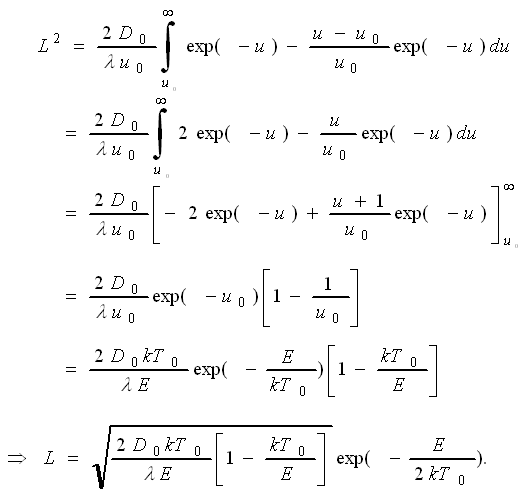
This gives us | ||||||||||
 |
|||||||||||
|
The second term of the Taylor expansion brought in the factor [1 – kT0/E] and since kT0 « E in all normal cases, it is indeed not very important. If we neglect it, we may simply give the desired solution as | ||||||||||
| |||||||||||
|
Now we can look at some typical cases and see what this formula means. However, first we have to find the right values for l | ||||||||||||
|
For this we have to take the given values of the initial cooling rate, which we call l', and see what l values correspond to these cooling rates. | ||||||||||||
|
The initial cooling rate l' is the derivative of the T(t) function at t = t0 = 0, we thus have | ||||||||||||
| |||||||||||||
|
and obtain | ||||||||||||
| |||||||||||||
|
The "–" sign cancels, because our l' must carry a minus sign, too, if it is to be a cooling and not a heating rate. | ||||||||||||
|
Replacing l by l'/T0 yields the final formula: | ||||||||||||
| |||||||||||||
|
We have to evaluate this formula for cooling rates l' given as (–) 1 oK/s, 10 oK/s, 50 oK/s, 104 oK/s, and activation energies of E = 1.0 eV, 2.0 eV, 5 eV. For D0 we take D0 = 10–5 cm2s–1. | ||||||||||||
|
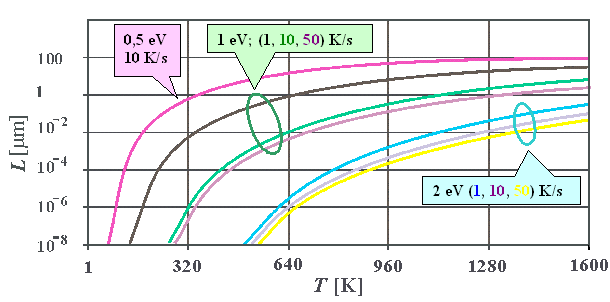
The result (including the [1 – kT0/E] term is shown below | ||||||||||||
| |||||||||||||
|
What can we learn from the formula and the curves? | ||||||||||||
|
| ||||||||||||
|
What can we do with the numbers? Quite simple:
| ||||||||||||
 Exercise 4.2-1 Diffusion During Cooling
Exercise 4.1-1 Lifetime of Positrons
© H. Föll (Defects - Script)
 With frame