|
This subchapter means to show that even the seemingly most simple defects - vacancies
and interstitials - can get pretty complex in real crystals. This is already
true for the most simple real crystal, the fcc lattice with one atom as a base, and very true for fcc lattices with
two identical atoms as a base, i.e. Si or diamond. In really complicated crystals
we have at least as many types of vacancies and interstitials as there are different atoms - it's easy to lose perspective.
|
|
 |
To give just two examples of real life with point defects: In the seventies
and eighties a bitter war was fought concerning the precise nature of the self-interstitial in elemental fcc crystals.
The main opponents where two large German research institutes - the dispute was never really settled. |
|
|
Since about 1975 we have a world-wide dispute still going on concerning the nature
of the intrinsic point defects in Si (and pretty much all other important semiconductors). We learn from this that
even point defects are not easy to understand. |
|
You may consider this sub-chapter as an overture to the point defect part of course:
Some themes touched upon here will be be taken up in full splendor there. Now lets look at some phenomena related to point
defects |
|
We start with a simple vacancy
or interstitial in (fcc) crystals which exists in thermal equilibrium and ask a few questions (which are mostly easily extended to other types of crystals):
|
| |
|
What is the atomic structure of point defects?
This seems to be an easy question for vacancies - just remove an atom! |
|
|
But how "big", how extended
is the vacancy? After all, the neighboring atoms may be involved too. Nothing requires you to have only simple thoughts
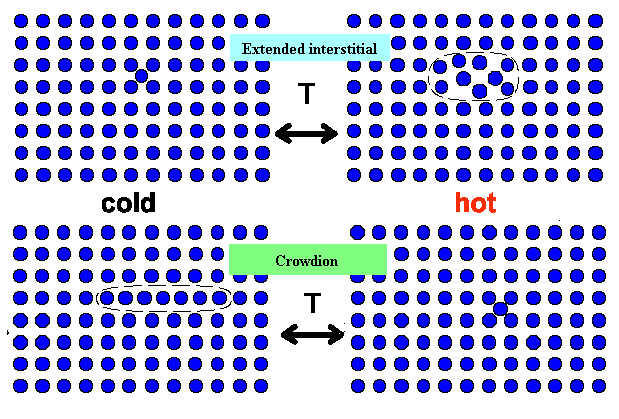
- lets think in a complicated way and make a vacancy by removing 11 atoms and filling the void with 10 atoms
- somehow. You have a vacancy. What is the structure now? |
|
|
How about interstitials? Lets not be unsophisticated either. Here we could fill our 11-atom-hole
with 12 atoms. We now have some kind of "extended" interstitial?
Does this happen? (Who knows, its possibly true in Si). How can we discriminate
between "localized" and "extended" point defects? |
|
|
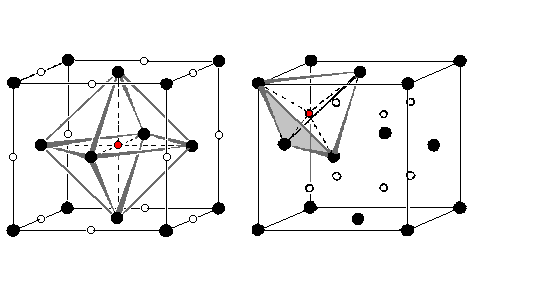
With interstitials you have several possibilities to put them in a lattice. You may choose
the dumbbell configuration, i.e. you put two atoms in the space of one
with some symmetry conserved, or you may put it in the octahedra or
tetrahedra interstitial position. Perhaps surprisingly, there is
still one more possibility: |
|
|
The "crowdion", which is supposed
to exist as a metastable form of interstitials at low temperatures and which was the subject of the "war" mentioned above.
|
|
|
Then we have the extended interstitial
made following the general recipe given above, and which is believed by some (including me) to exist at high temperatures
in Si. Lets see what this looks like: |
|
|
|
|
Next, we may have to consider the charge state
of the point defects (important in semiconductors and ionic crystals). |
|
|
Point defects in ionic crystals, in general, must be charged for reasons of charge neutrality.
You cannot, e.g. form Na-vacancies by removing Na+ ions without either giving the resulting vacancy
a positive charge or depositing some positive charges somewhere else. |
|
|
In semiconductors the charge state is coupled to the energy levels introduced by a point defects,
its position in the bandgap and the prevalent Fermi energy. If the Fermi
energy changes, so does, perhaps, the charge state. |
|
Now we might have a coupling between charge state and
structure. And this may lead to an athermal diffusion mechanisms; something really strange (after Bourgoin). |
|
|
Just an arbitrary example to illustrate this: The neutral
interstitial sits in the octahedra site, the positively charged one in the tetrahedra
site (see below). Whenever the charge states changes (e.g. because its energy level is close to the Fermi energy or because
you irradiate the specimen with electrons), it will jump to one of the nearest equivalent positions - in other word it diffuses
independently of the temperature. |
| |
|
|
These examples should convince you that even the most simplest of defects - point
defects - are not so simple after all. And, so far, we have (implicitly) only considered the simple case of thermal
equilibrium! This leads us to the next paragraph: |
|
|
|
The list above gives an idea what could happen. But what,
actually, does happen in an ideal crystal in thermal equilibrium?
|
|
|
While we believe that for common fcc metal this question can be answered, it
is still open for many important materials, including Silicon. You may even ask: Is there thermal
equilibrium at all? |
|
|
Consider: Right after a new portion of a growing crystal crystallized from the melt, the
concentration of point defects may have been controlled by the growth kinetics and not by equilibrium. If the system now
tries to reach equilibrium, it needs sources and sinks for point defects to generate or dump what is required. Extremely
perfect Si crystals, however, do not have the common sources and sinks, i.e. dislocations and grain boundaries. So
what happens? Not totally clear yet. There are more open questions concerning Si; activate the link
for a sample. |
|
Well, while there may be some doubt as to the existence of thermal equilibrium
now and then, there is no doubt that there are many occasions where we definitely do not have thermal equilibrium. What
does that mean with respect to point defects? |
|
|
|
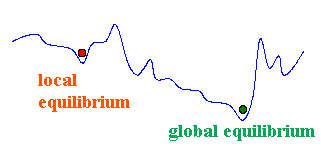
Global equilibrium, defined by the absolute minimum
of the free enthalpy of the system is often unattainable; the second best solution, local
equilibrium where some local minimum of the free enthalpy must suffice. You always get non-equilibrium, or just a local
equilibrium, if, starting from some equilibrium, you change the temperature. |
|
|
Reaching a new local equilibrium of any kind needs kinetic processes where point
defects must move, are generated, or annihilated. A typical picture illustrating this shows a potential curve with various
minima and maxima. A state caught in a local minima can only change to a better minima by overcoming an energy barrier.
If the temperature T does not supply sufficient thermal energy kT, global equilibrium (the deepest
minimum) will be reached slowly or - for all practical purposes - never. |
| |
|
|
|
One reaction helpful for reaching a minima in cases where both vacancies and interstitials
exist in non-equilibrium concentrations (e.g. after lowering the temperature or during irradiation experiments) could be
the mutual annihilation of vacancies and interstitials by recombination. The potential barrier that must be overcome seems
to be only the migration enthalpy (at least one species must be mobile so that the defects can meet). |
|
|
There might be unexpected new effects, however, with extended defects. If an localized interstitial
meets an extended vacancy, how is it supposed to recombine? There is no local empty space, just a thinned out part of the
lattice. Recombination is not easy then. The barrier to recombination, however, in a kinetic description, is now an entropy barrier and not the common energy barrier. |
|
Things get really messy if the generation if point defects, too, is a non-equilibrium
process - if you produce them by crude force. There are many ways to do this: |
|
|
Crystal Growth
As mentioned above, the incorporation of point defects in a growing interface does not have to produce the equilibrium concentration
of point defects. An "easy to read" paper to this subject (in German) is available in the Link
|
|
|
Quenching, i.e. rapid cooling. The point defects
become immobile very quickly - a lot of sinks are needed if they are to disappear under these conditions - a rather unrealistic situation.
|
|
|
Plastic deformation,
especially by dislocation climb, is a non-equilibrium source (or sink) for point defects. It was (and to some extent still
is) the main reason for the degradation of Laser diodes. |
|
|
Irradiation
with electrons (mainly for scientific reasons), ions (as in ion implantation; a key process for microelectronics), neutrons
(in any reactor, but also used for neutron transmutation doping of Si),
a-particles (in reactors, but also in satellites) produces copious quantities of point
defects under "perfect" non-equilibrium conditions. |
|
|
Oxidation of
Si injects Si interstitials into the crystal. |
|
|
Nitridation
of Si injects vacancies into the crystal. |
|
|
Reactive Interfaces
(as in the two examples above), quite generally, may inject point defects into the participating crystals. |
|
|
Precipitation
phenomena (always requiring a moving interface) thus may produce point defects as is indeed the case: (SiO2-precipitation
generates, SiC-precipitation uses up Si-interstitials. |
|
|
Diffusion
of impurity atoms may produce or consume point defects beyond needing them as diffusion vehicles. |
|
And all of this may critically influence your product. The Si crystal
growth industry, grossing some 8 billion $ a year, continuously runs into severe problems caused by point defects that are not in equilibrium.
|
|
|
So-called swirl-defects, sub-distinguished
into A-defects and B-defects caused quite some excitement around 1980 and led the way to the acceptance
of the existence of interstitials in Si. |
|
|
Presently, D-defects are the hot
topics, and it is pretty safe to predict that we will hear of E-defects yet. |
|
Now, most of the examples of possible complications mentioned here are from pretty
recent research and will not be covered in detail in what follows. |
|
|
And implicitely, we only discussed defects in monoatomic crystals - metals, simple semiconductors.
In more complicated crystals with two or more different atoms in the base, things can get really messy - look at chapters 2.4 to get an idea. |
|
|
Anyway, you should have the feeling now that acquiring some knowledge about defects is not
wasted time. Materials Scientists and Engineers will have to understand, use, and battle defects for many more years to
come. Not only will they not go away - they are needed for many products and one of the major "buttons" to fiddle
with when designing new materials |
© H. Föll (Defects - Script)