|
There is not much to say about conventional light sources like simple light bulbs,
"halogen" light bulbs, gas-discharge sources and so on. You all are quite familiar with them. What follows gives
the bare essentials. |
|
 |
Thomas Edison is usually
credited as inventor of the light bulb in 1880 but there were many others working on "light bulbs" as early
as 1840. Edison's breakthrough probably was due to a combination of three factors: an effective incandescent material,
a higher vacuum compared to others, and a high resistance that made power distribution at high voltages from a centralized
source economically viable. |
|
|
Consider a 100 W bulb operated at 230 V. It draws 0,44 A and thus has
a resistance of 227 W. This is not easily achieved with the metal wires then available.
Edison of course, used carbon. It took until about 1905 before tungsten (W) filaments were used and until
about 1913 before an inert gas like N2 was inside the bulb instead of vacuum. |
|
|
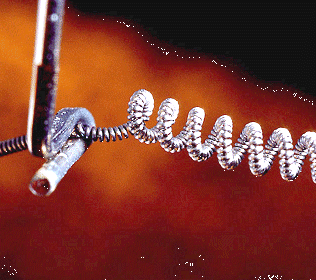
In fact, present day light bulbs are high-tech objects despite their lowly image. If you have
doubts about this consider: How would you make a "coiled coil" filament as shown below for a standard 1 €
light bulb a from an extremely hard to shape material like W in such a way that it is extremely cheap? |
| |
 |
 | | Edisons light bulb |
Modern double coiled W filament |
| Source: Wikipedia |
|
|
It is hard for us to imagine the impact of "easy" light on humankind.
Nevertheless, the 120+ years of illumination by incandescent light has to
come to an end right now for reasons already
given |
|
Fluorescent and gas discharge light sources have better efficiencies (and efficacies) than "black body radiators" but are not without problems
of their own. |
|
|
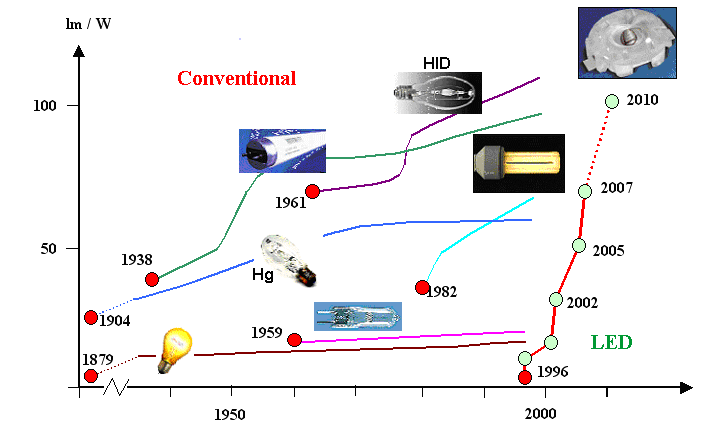
The pictures tells it all, just look at the LED branch. No more needs to be said about "conventional
light sources". |
|
|
 |
 |
HID = "high intensity discharge" light bulb;
the "Xenon" light in
your more expensive car.
FL = "fluorescent light"
Hg = "mercury vapor lamp"
GL = "Glühlampe
" (Glowing light); light bulb
LED = light emitting diode
Data from Osram |
|
| | |
|
|
Light Emitting Diode |
| |
|
| |
Light emitting diodes or LED's nowadays come
in two variants: "Standard" LED's made from inorganic crystalline semiconductors
based on, e.g., GAAlAs, GaP or GaN and "organic" LED's or
OLED's.
|
|
|
OLED devices are coming into their own right now (2011). They are not
yet mass products for general lightning applications but we will find out how far they will go in the near future (based
on the work of possibly you and other materials scientists and engineers; who else?). |
|
|
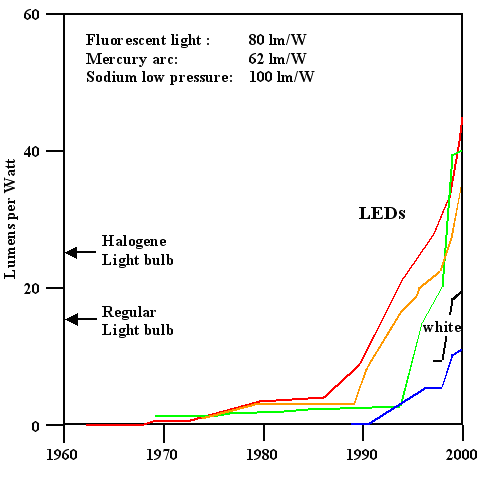
Standard LED's have been around for more than 40 years by now. However, they used to
be only red in the beginning, see the picture below, and their efficiencies were lousy. The breakthrough came around 1990
when Shuji Nakamura of Nichia Corporation almost single-handled introduced the GaN
based blue LED. This started the ongoing revolution of world wide lighting that will contribute in a major way to
saving the planet from the climate crisis. Of course, if you google "Nakamura" you will find a soccer player first. |
|
The picture below gives an idea of what was happening. Nobody seem to have updated
this picture but the trends continued. The LED market is growing rapidly |
| |
|
|
|
In analogy to "Moore's law", "Haitz's
Law" has been proposed: In every decade, the cost per lumen (unit of useful light
emitted) falls by a factor of 10, the amount of light generated per LED package increases by a factor of 20,
for a given wavelength (color) of light. Haitz also predicted that the efficiency of LED-based lighting could reach
200 lm/W (lumen per Watt) in 2020 crossing 100 lm/W in 2010. |
|
|
This is important: |
| |
More than 50% of the electricity consumption
for lighting or
20% of the totally consumed electrical energy
would be saved reaching 200 lm/W |
|
|
|
So get going, young Material Scientist! |
|
What does on need to do to make better (and cheaper) LED's? |
|
|
As a first step you must learn a minimum about semiconductor physics or Halbleiterphysik
and semiconductor technology. |
|
|
The links provide starting points because we are not going to do
that here. |
| |
| |
|
Laser |
| |
|
| |
All the light sources discussed so far share certain broad characteristics: |
| |
- They emit either a whole spectrum, i.e. light with many colors, several spectral
lines, or in the case of LED's only one line but with a rather large half-width.
- Their light may come from a small area ("point source"; e.g. standard LED), from a longish area ("fluorescent
tubes") or even from a large area (OLED's) and cannot really be processed into that parallel
beam always used for illustrating optical stuff
- The light is emitted in many directions with various characteristics but never in only one direction.
- The light is never fully coherent and mostly rather incoherent.
- The light is mostly not polarized
|
|
Negate everything in that list (except, maybe, polarization) and you have a Laser, a device that operates on the principle of Light Amplification by Stimulated Emission
of Radiation. |
|
Lasers are rather recent light sources; the first one was built by Maiman in 1960; for a short history use the link |
|
|
We cannot go much into the principles of Lasers here. We only look at a few basic
concepts and keywords.. |
|
The name "LASER" says it all. To understand the very basic principles
of Lasers, we look at a sequence of a few simple pictures |
| | |
|
|
First we need Light
Amplification. For that we need a material with two suitable energy levels, DE = hn apart. Light results whenever the electron jumps from
the higher level to the lower (ground) level one with a basic frequency of n Hz. Note
that this is not true for just any levels; the electron may get rid of its energy in other ways, too, e.g. in indirect semiconductors. |
|
|
|
|
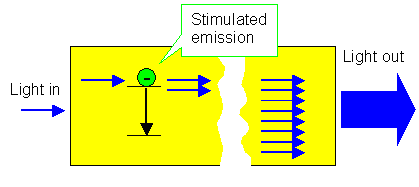
Second we need stimulated emission,
a phenomenon that was calculated and predicted by Albert
Einstein in 1916. In simple terms,
stimulated emission means that a photon with the energy DE, when encountering an
electron sitting on the upper energy level, stimulates it to "fall down" and to emit a photon that is identical
in wave vector, and phase to the one that stimulates the process (and does not get absorbed!) |
|
|
|
Instead of one photon we have now two identical one. We have achieved
light amplification. The two photons now stimulate other electrons along their
way to produce more photons, all being fully coherent.. A lot of light now merges from
the output. |
| | |
|
|
The process from above, however, only works once - until all electrons that happens
to populate the upper energy level are "down". | |
|
|
|
For a material with a dimension of 1 = 1 cm this takes about t
= cmat /l
» [1/(2 · 109)] s = 0,5 ns, so we would have a rather short light
flash. | |
| |
|
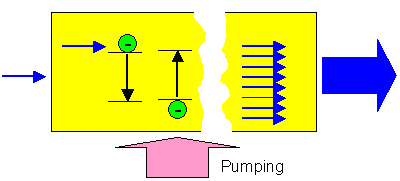
or a "cw" or continuous wave Laser we obviously need
to kick the electrons up to the higher energy level - just as fast as they come down - by "pumping"
the Laser. In fact, we need to have more elctrons sitting at the high energy level all the times than at the lower level.
This is a very unusual state for electrons called inversion. |
|
|
|
Pumping requires that we put
plenty of energy into the system all the time. This can be done by intense illumination (obviously with light of somewhat
higher energy than DE). Some Lasers of the US military were supposed to be pumped
by X-rays produced by a nuclear explosion (no joke). They would not live long but still be able to produce a short-lived
ultra-high intensity Laser beam suitable for shooting down missiles. |
| |
|
Our cheap, simple and long-lasting semiconductor lasers, in contrast,
are "simply" pumped by running a very large current density (> 1000
A/cm2) through a suitable pn-junction in some direct semiconductors.
This link gives an idea of what that means.
|
| |
|
Note that the incoming photon could just as well kick a lower electron
up, than it would be absorbed. The photon generated at random some time later
when the electron moves back down again is not adding to the desired output, it just
adds noise. |
| | |
|
|
We are not done yet. The picture above are greatly simplified because in reality
we would produce light beams running in all kinds of directions. That's not what we want. |
|
|
|
|
Just as important, the energy of the light produced would not be exactly DE but, roughly, DE ± kT since our
excited electrons would also have some thermal energy. For a good monochromatic light, an energy or frequency spread of
about 1/40 eV at room temperature is ridiculously large, so we must do something. |
|
|
|
What we do is putting the pumped material inside a "Fabry Perot"
resonator. This is nothing else but two mirrors (one with a reflectivity less
than 100 %, i.e. "semi" transparent) that are exactly parallel (within fractions of a µm) and
at a distance L from each other. |
|
|
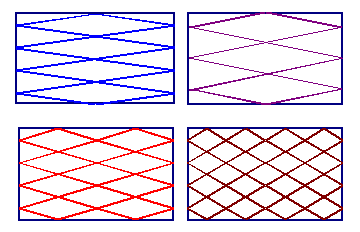
The light generated then is reflected back and forth. For reasons
clear to us now, only waves with l = 2L/m;
m = 1,2,3,... will "fit". |
|
|
A certain part of the light impinging on the "semi" transparent
mirror leaks out, forming our .now fully monochromatic and coherent Laser beam.It propagates in one directiononly (here
perpendicular to the mirrors). |
| |
| |
|
The way to visualize that is shown here. |
|
|
|
|
We have one standing wave right between the two mirrors. Note that the wave length
in the material is different from that in air; you must take that into account when going through numbers. |
|
|
|
Note that the picture for an organ pipe with an acoustic wave inside would, in
principlelook exactly the same. The pipe would leak some of the wave and you hear a tone with a well defined frequency. |
|
|
|
This looks pretty involved, so how come that we have ultra-cheap
Lasers in DVD drives? Because you don't need extra mirrors, you just use the internal surface of your semiconductor single
crystal that reflect parts of the beam according to the Fresnel equations. If you
obtain those surfaces by cleaving down a low-index plane, they are automatically exactly plane parallel. That makes Lasers
more simple. |
|
|
However, typically Lasers are far more complicated than shown here |
| | |
|
| |
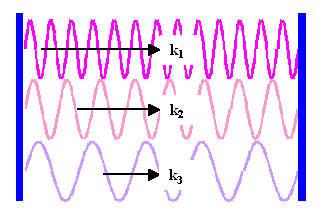
An organ pipe or any longish musical instrument will not only produce a tone with
one frequency n0 but also the harmonics or overtones m · n0.
Same for our Laser, of course, as shown below left. |
|
|
|
|
|
A musical instrument that isn't long and slender like an organ pipe or a flute
(i.e. an essentially 1-dim. system) but a rectangular box (or a complex-shaped body shape like a violin, can contain standing
waves in all directions with many possible wavelengths. Same for our Laser; cf.. the situation in the figure on the upper
right. |
|
So depending on the exact shape of the laser, the way it's pumped, and so on and
so forth, there can be more than just one Laser mode |
|
|
We needed to get to that word. so let's repeat: There can be more than just one standing wave
inside a Laser resonator, or a real laser might emit more than just one mode. |
|
We will not discuss what kinds of Lasers we find for all kinds of applications
here. There is a bewildering variety and more and more different kinds are introduced. We just note one important item: |
|
|
Increasing the frequency / energy of Lasers becomes "exponentially" difficult because
with increasing photon energy the number of ways it can be absorbed increases rapidly (there are lot of empty states far
above some densely populated ground level onto which electrons could be "kicked") but only one state is useful
for lasing! |
|
|
That's why there aren't so many UV Laser around and no X-ray Lasers yet. |
© H. Föll (Advanced Materials B, part 1 - script)