|
The charge density r of the electrons then is
|
| |
|
|
In an electrical field E a force F1 acts on charges given by
|
| |
|
|
 |
We will now drop the underlining for vectors and the mauve
color for the electrical field strength E for easier readability. |
|
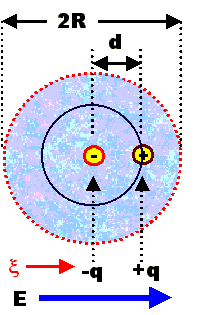
The positive charge in the nucleus and the center of the negative charges from
the electron "cloud" will thus experience forces in different direction and will become separated. We have the
idealized situation shown in the image above. |
|
The separation distance d will have a finite value because the separating
force of the external field is exactly balanced by the attractive force between the centers of charge at the distance d.
|
|
|
How large is his attractive force? It is not obvious because we have to take into account
the attraction between a point charge and homogeneously distributed
charge. |
|
|
The problem is exactly analogous to the classical mechanical problem of a body with mass m
falling through a hypothetical hole going all the way from one side of the globe to the other. |
|
|
We know the solution to that problem: The attractive force between the point mass and the
earth is equal to the attractive force between two point masses if one takes only the
mass of the volume inside the sphere given by the distance between the center of the spread-out mass and the position of
the point mass. |
|
|
Knowing electrostatics, it is even easier to see why this is so. We may divide the force on
a charged particles on any place inside a homogeneously charged sphere into the force from the "inside"
sphere and the force from the hollow "outside" sphere. Electrostatics teaches
us, that a sphere charged on the outside has no field in the inside,
and therefore no force (the principle behind a Faraday cage). Thus we indeed only have
to consider the "charge inside the sphere. |
|
For our problem, the attractive force F2 thus is given
by |
| |
| F2 = |
q(Nucleus) · q(e in d)
4p
e0 · d 2 |
|
|
|
|
with q(Nucleus) = ze and q(e in d) = the fraction of the charge of the
electrons contained in the sphere with radius d, which is just the relation of the volume of the sphere with
radius d to the total volume . We have |
| |
| q(e in d) = ze · |
(4/3) p · d 3
(4/3) p · R 3 |
= | ze · d
3
R 3 |
|
|
|
|
and obtain for F2: |
| |
| F2 = |
æ
ç
è |
(ze) 2
4 pe0 · R
3
|
ö
÷
ø |
· d |
|
|
|
We have a linear force law akin to a spring; the expression in brackets is the
"spring constant". Equating F1 with F2 gives the equilibrium
distance dE. |
|
|
|
|
Now we can calculate the induced dipole moment
m, it is |
|
|
|
m = ze · dE = 4 pe0 · R 3 · E |
|
|
|
The polarization P finally is
given by multiplying with N, the density of the dipoles; we obtain |
| |
| P = 4 p
· N · e0 · R 3 · E
|
|
|
|
Using the definition
P = e0 · c
· E we obtain the dielectric susceptibility resulting from atomic polarization,
catom |
|
|
|
|
Let's get an idea about the numbers involved by doing a simple exercise: |
| |
|
|
This is our first basic result concerning the polarization of a material and its
resulting susceptibility. There are a number of interesting points: |
|
|
We justified the "law"
of a linear relationship between E and P for the electronic polarization mechanism (sometimes
also called atomic polarization). |
|
|
We can easily extend the result to a mixture of different atoms: All we have to do is to sum
over the relative densities of each kind of atom. |
|
|
We can easily get an order of magnitude for c. Taking a
typical density of N »
3 · 1019 cm– 3 and R »
6 · 10– 9 cm, we obtain |
|
|
c »
8,14 · 10– 5, or
er = 1, 000 0814 |
|
|
In words: the electronic polarization of spherical
atoms, while existent, is extremely weak. The difference to vacuum is at best in the
promille range. |
|
Concluding now that electronic polarization is totally unimportant,
would be premature, however. Atoms in crystals or in any solids do not generally have spherical
symmetry. Consider the sp3 orbital of Si, Ge or diamond. |
|
|
Without a field, the center of the negative charge of the electron orbitals will still coincide
with the core, but an external field breaks that symmetry, producing a dipole momentum. |
|
|
The effect can be large compared to spherical s-orbitals:
Si has a dielectric constant (DK) of 12, which comes exclusively from electronic polarization! Some
values for semiconductors are given in the link. |
| |
|
© H. Föll (Advanced Materials B, part 1 - script)